


The first few episodes of season 1 of the Zenze podcast are out. Human rights and fundamental freedoms are great equalizers that cut across different cultures, races, religions in general. Throughout this series we mainly focus on fundamental freedoms that are in Article 21 of the Constitution of Namibia. In the first episodes we look at how the freedom to practice any religion and to manifest such practice found in Article 21(1)(c).
Brief History
Human rights and fundamental freedoms all started from an agreement known as the Magna Carta in the 1200s. The Magna Carta came about because King John wanted to keep increasing taxes, and there were other rules too that could easily be made up and enforced by the king, like trading off women, taking portions of land and just generally breaking the law at will. The landowners/barons at the time revolted, and the king decided to negotiate with them and on the 15th of June 1215, a document called the Magna Carta was signed which was created to make sure that no one, even the king was not above the rule of law.
In Namibia, human rights and fundamental freedoms came with the Constitution in 1990 with a similar goal to make sure that no one was above the law, so Article 1(6) states “This Constitution shall be the supreme law of Namibia” The point is to ENJOY fundamental freedoms and human rights.
How did they determin which values to protect?
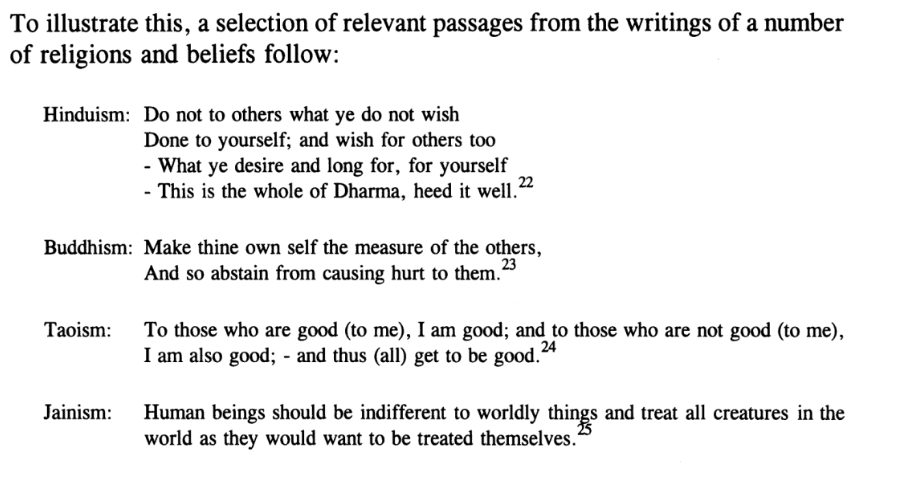
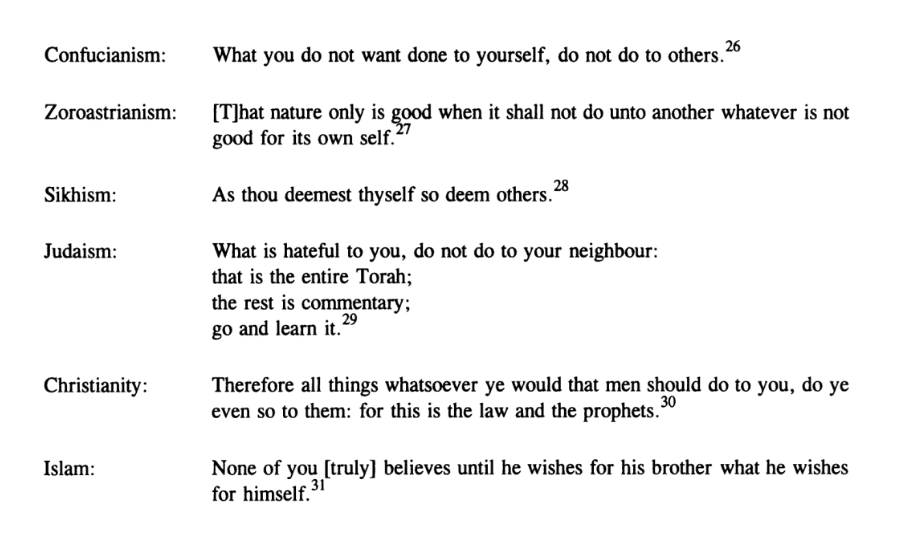
Under the Namibian Constitution, religion is a possible grounds of discrimination under Article 10. Determining this took a while, but here is just a snippet of some of the history. The task of having to find rules that satisfy everyone couldn’t have been an easy one, but after world war 2 it was clear that a baseline was needed, many of the principles were based on the golden rule- “Do unto others as you would want them to do unto you”. In 1960 a study carried out by the UN helped to identify the baseline values that tie several religious and faith groups together. Source: Freedom of Religion by Bahiyyih and Tahzib

Human right vs Fundamental Freedom
Human rights are based on international agreements whereas fundamental freedoms are based on the constitution.
Why is this fundamental freedom important?
- State history
An essay titled “Namibia’s Constitution, an extraordinary document” written for the annotated version of the Constitution talks about this, as one of the special features of Namibia’s constitution. It states that, “After the end of Apartheid it was the wish of most members of the Constituent assembly that Namibia would become a secular state without a state religion. The explicit separation of State and Church was important to them as the NG Church of the Afrikaans (white) people had been a close political ally of the Apartheid Government.” It goes on to speak about how this church had a strong influence on the education system. The post-apartheid government wanted to make sure that people get to choose the faiths they want to believe in and if they want a faith at all. Not as an attack against the church but as a sign of respect towards the views of each person in Namibia for as long as they do not harm or promote harm. In each episode of the podcast each person speaks of how they found their way to their faith and each one shares a unique way of how they have enjoyed this right. In episode 2 Mayvis speaks of how becoming a Lutheran Christian involved learning the history of the faith and making an informed decision on why and how she wanted this to be a part of her life.
- Creating room for discourse
The apartheid era government did not allow for much room for people to share thoughts. It was not just a matter of one faith, but also narrower interpretations of that faith with little room for questioning. The goal was to move from a system of imposition to one of inclusive decision making. The preamble states that “The Constitution forms the foundation of our peaceful coexistence…” In this way room is made for the many diverse voices in Namibia to be heard. Making use of this knowledge is intended to empower the individual and strengthen communities.
- Informing everyday lives
The Constitution, human rights and fundamental freedoms are often discussed in terms of massive contentious topics, and important big picture issues such as education, national budgeting and state accountability. The Constitution and these fundamental freedoms were also created to help empower people on a small scale, it “determines the everyday life of each individual.” In episode 3 of the podcast Pepe talks about how exercising this freedom allowed for a perception change when it came to school to make reading a lot more fun, this is how Pepe managed to improve grades at school and find a new hobby.
Conclusion
In conclusion….listen to the podcast.
 ZENZE
ZENZE 