UNO and HATAGO : Review

***SPOILERS***

RATING: PG (Depictions of Sexual Assault)
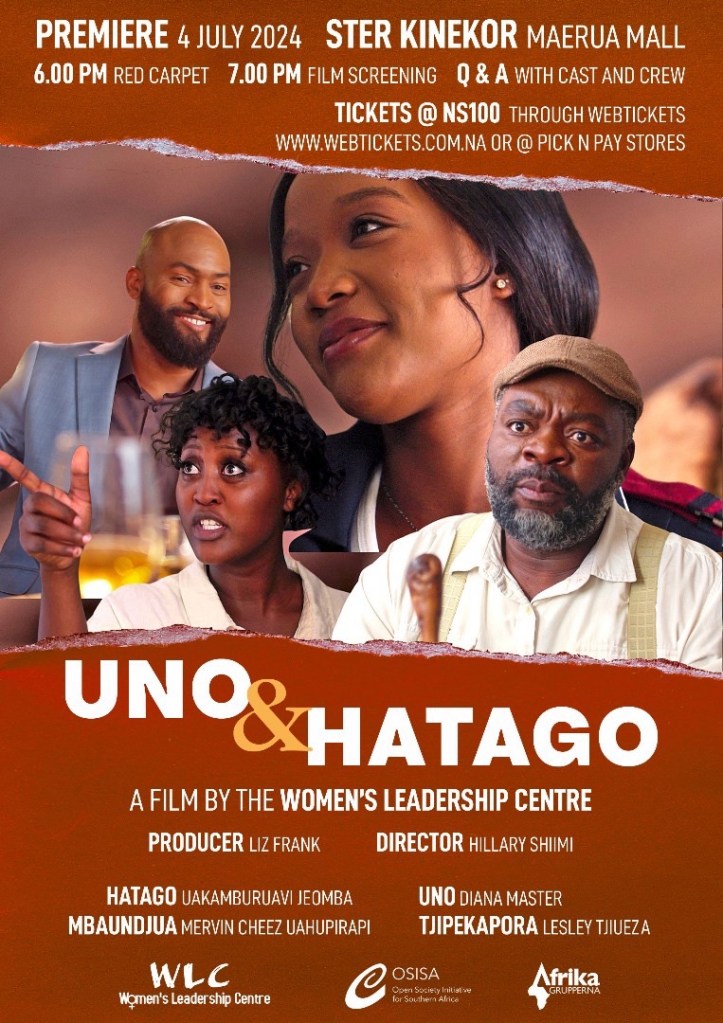
Uno and Hatago is an aptly timed production. It was largely marketed as a lesbian film, and it is, but it goes beyond that by addressing harmful cultural practices and promoting unity.

Uno and Hatago follows the story of a nurse, Uno, played by Diana Master, who’s world suddenly crashes when her family finds out about her sexual orientation. Up until then, Uno had been living in Windhoek with her partner Hatago, a feminist and LGBTQ+ rights activist played by Uakamburuavi Jeomba.

Patriarchy, Family Secrets and Tradition

The film is centered on how Uno’s family of OvaHerero traditionalists react to finding out that she is a lesbian woman. The traditionalism is explored from two ends. First is the ‘traditionalist’ idea that lesbianism is not acceptable or that is something foreign, and second is a traditionalism which acknowledges that lesbian women (and other members of the LGBTQ+ community) have always existed in Namibia and that true tradition is that this is not unAfrican.  

The patriarchal nature of the first perspective is perfectly portrayed by Uno’s uncle, played by Mervin Cheez Uahupirapi, and her father, played by Lesley Tjiueza. These two played these characters so well, I left the theatre with so much animosity for fictional characters. The way they are written doesn’t stretch far from reality at all, the audience is likely to think of characters in their own lives who are like these two.

We meet Uno’s uncle during an intimate gathering at a restaurant, where they (Uno, Hatago and a few of their friends), have gone to celebrate Uno’s graduation. During that same night, Uno’s uncle is having dinner with his girlfriend, an extra-marital partner. His girlfriend insists on taking a picture of him, and as he protests this, he notices that she also captured his niece, Uno, kissing a woman right behind him. Suddenly his focus turns away from the possibility of being caught cheating to excitement having caught his niece in what he considers to be a cultural ‘sin’. He asks his girlfriend to share this picture with him and takes it to her father under the guise of taking immediate action to save the family’s reputation. His solution to this is to marry her off to Tove, his nephew with seemingly low marital prospects. The two agree on a dowry that Uno’s father can pay and thereafter, call Uno to the homestead to tell her that they found out about her ‘city life antics’ and about the marriage they have organized for her. In line with unspoken cultural norms, this uncle sexually assaults Uno to ‘prepare her’ for marriage.

Her father shows pride in his recently graduated daughter for her qualifications before completely discarding that in favour of viewing her as a shameful person. From the moment he finds out that his daughter is a lesbian, he focuses on hiding this “shame.” Essentially, it seems like, she is not truly successful if she does not let a man dominate her. He expresses this more by defending her uncle and disowning her after she reports the assault and carries on her relationship with Hatago. Embracing her lesbianism is a rebellion against the idea that she is not a real woman if she is not in a relationship with a man, just as being gay may be falsely viewed as not ‘real manhood’ if one is not dominant over a woman.

This form of ‘traditionalism’ which focuses on filling heteronormative and patriarchal templates completely undermines that dignity of women and this film explores this in a realistic way. The fact that Uno’s uncle was cheating is a non-issue while Uno’s committed and healthy relationship is. The fact that he has violated his niece is less of an issue than the fact that she is a lesbian, even to the police officer who recieves the matter.

It is Uno’s grandmother who sheds light on another of the other view of ‘traditionalism.’ The idea that lesbianism has always existed and that assault on women is an unacceptable norm. She helps Uno escape and return to the city after finding out that her uncle has attacked her, and the film ends with her sharing a story of a same-sex partner that she had before being married off to her husband. She shares about the grief she experienced when that partner passed away and the pain she felt not being able to express the extent of that grief given the nature of their relationship. She emphasizes togetherness through love and acceptance within a family, rather than allowing harm to go on, in the name of protecting family honour. She frames honour as being something that can come from showing up for each other rather than maintaining socially imposed images. In this case, the images of the ‘macho men’ and ‘high achieving, good girl daughter.’

Uno’s mother starts off with a similar stance to that of her husband. Rejecting her daughter because of her sexual orientation. However she gradually leans towards accepting her daughter after seeing that her family is becoming torn apart because of this, and worse still, that Uno’s sexual orientation has not stopped her from becoming a productive, successful and helpful member of society, or from having a child. Throughout the film, she maintains a regal and stoic disposition, not showing affection and avoiding vulnerability until it becomes clear that her husband’s stubbornness may force Uno to completely cut them off. This may have also been amplified when she meets her daughters mother-in-law, Buruxa (I hope I spelt that right), who shows unconditional love, encouragement and acceptance to Uno. Buruxa is the mother Uno needed and this may not have landed well with Uno’s biological mother. Soon enough, she takes on the grandmother’s stance, to lean into love and acceptance, while maintaining her rigid mannerisms. The character doesn’t change drastically, but in subtle ways like inviting Uno home and making her tea, and in her most expressive moment when she stands up for Uno to her husband, pointing out that his pursuit of family honour is fueled by hatred and that this is not the kind of family that can stay together for very long. She seems to represent anyone who has experienced this changing of perspectives, from a tradition rejection to one of radical acceptance.

Criticisms

Unfortunately we do not get to see Uno’s mother reacting to the assault and we do not get to see her express pride in her daughter’s achievements. We just see her expressing a whole lot of disappointment and coldness. Which can bring up the question of whether her distant nature is just who she is or if it came as a result of finding out that her daughter is a lesbian. Sure, Uno becomes tense when she notices that her mother is upset with her but the inexpressiveness seems to continue even after they have made amends, and seems to be there when Uno’s grandmother shares her story. It is not clear if we should expect affection from this woman if this is the personality she has always had or if she has taken on this persona as a reaction to Uno being a lesbian.

With the exception of Uno and Hatago’s friends whose cultural backgrounds and sexual orientations remain a mystery, the OtjiHerero heterosexual women we meet are all homophobic. On the other end of the scale, Buruxa, the only other woman we meet who is accepting of Uno and Hatago’s relationship, is of Damara heritage. Her sexual orientation doesn’t come up, but there would have been some reality balance in seeing a non-Herero speaking homophobe or a non-LGBTQ+, OtjiHerero speaking ally. This may come off as pitting the two customary groups against each other in how they view LGBTQ+ issues given that Namibia has the added context of tribalism and these two groups are mentioned on opposing ends of this issue.  (But then again, the existence of this dynamic in this one story doesn’t mean there’s no alternative dynamic elsewhere, so don’t miss the plot by centralizing these criticisms)

Conclusion

More LGBTQ+ stories are needed in media, especially one’s like this one that humanize same-sex partners. Homophobia is just dispensed without consideration for the humanity of the people being attacked and the fact that they too are members of society (Just scroll through the comments section of any LGBTQ+ related post on the Namibian pages, it’s a mess). Beyond this, the authenticity of LGBTQ+ stories told by a predominantly LGBTQ+ production team didn’t go past any of the audience members, and likely contributed to how impactful the overall story is. The story touches on other themes that are not LGBTQ+ centric such as family, harmful cultural practices, civic action, women’s rights, gender norms and romance (I didn’t get into it but Hatago is such a supportive and loving partner, they’re a wholesome couple which makes it so much easier to root for them. The way their relationship is depicted is enjoyable and if not for the political aspect of this movie, you may want to watch it for the romance story.)

Definitely a must watch.
How the Pride Movement in Namibia Is Fighting Colonial Laws

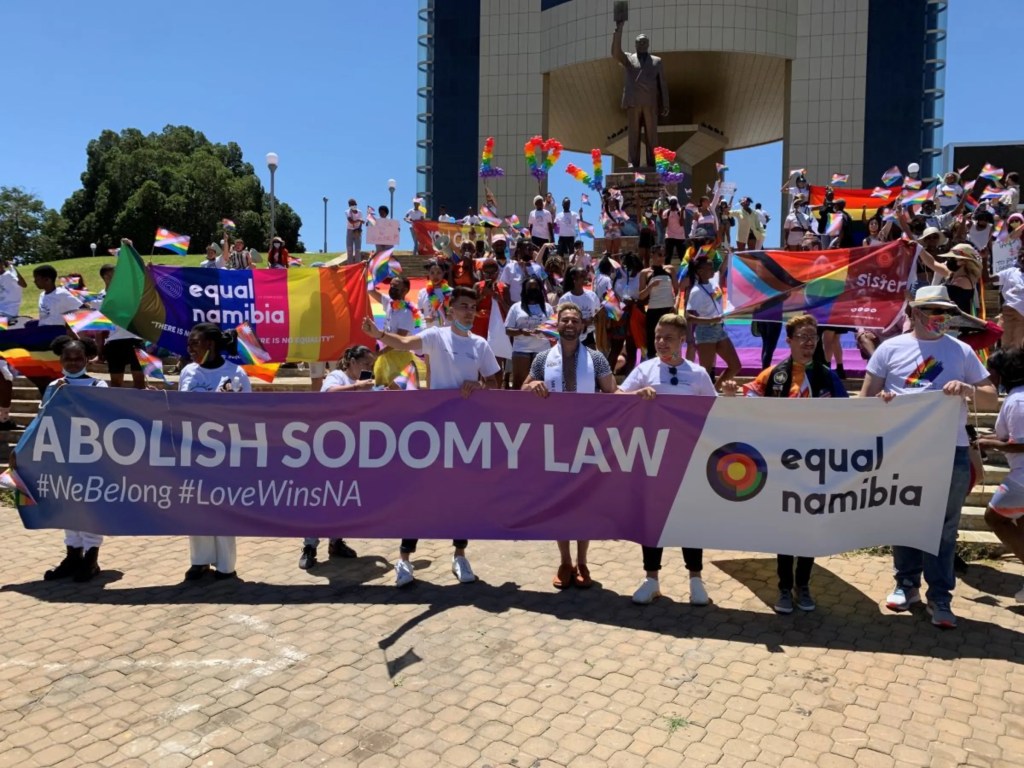
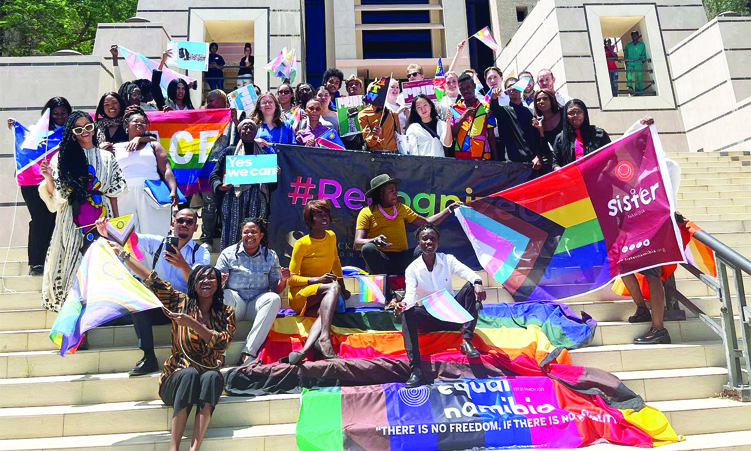
On the 21st of June 2024 the High Court of Namibia ruled in favour of declaring the sodomy law unconstitutional in the case of Dausab v the Government of Namibia. This follows years of activism alongside a steadily rising amount of homophobic attacks and an Anti-Gay Bill. We are in a pride revolution and here’s why its an important step against colonialism and genocide…

What does this have to do with colonialism?

Before colonialism, being gay was a norm. This sounds like a taboo to many who have fed into the false idea that tradition justifies homophobia. In many African countries, the word “gay” was normal enough to acquire its own title. For example; Eshenge in OshiWambo, Ngochani in ChiShona and Adofuro in Yoruba.

In the Namibian Ovambo cultural context it was believed that these men simply possessed a feminine spirits and were regular members of the community rather than ostracized minorities. German anthropologist Kurt Falk confirmed this during the 1920s having spent time with several Namibian tribes, including the Ovambo, OvaHerero, Nama and Himba. Ethnologist, Carlos Estermann supported this during the 1970’s and added that it was a culturally acknowledged ‘third gender’. The very first anti-homosexual trial was conducted under the German colonial rule. Four German men were banished for having defied paragraph 145 of the German Code which outlawed sodomy. This outlawing of sodomy was carried on by the South African colonial regime after taking over Namibia as a protectorate. If it isn’t already clear, the anti-homosexual laws were not born of tradition but of colonialism.

Over time, the colonial effect of self-rejection (a phenomenon whereby subjects to colonialism consciously reject colonialism but have learned to look down on their ethnic origins, cultural groups, cultures and customs) included a rejection of the LGBTQ+ community. Colonialism left in its wake, many with the idea that “all are equal but some more equal than others.” In our context, this idea from George Orwell’s animal farm wasn’t limited to just financial pursuits, but to the pursuit of love and happiness as well. A 2013 baseline study revealed that about 73% of nmaibians were under the impression that members of the LGBTQ+ community were accorded equal rights. This has not been true since the pre-colonial era. It has since become more evident that many are more aware of their own rights than those of others. So when words like moffie  are blurted out in the same tone as the word nigger or kaffer , it is easy to play it off as common rhetoric despite the fact that such terms are intended to humiliate and undermine an entire group of people for natural differences that they have no control over. Worse still, many have used these rhetorics and the laws supporting them to justify their violence and hatred, and further to pervert religion to suit these hateful narratives in the name if dispensing justice for God’s wrath. But that’s another conversation. In short, the same way colonial laws emboldened racist attacks, is the same way anti-homosexual laws embolden homophobic attacks. The same way racism was rationalized to seem like something morally acceptable, is the same way homophobia is rationalized to seem like the more morally acceptable stance. It is not.

The Dausab v Government of Namibia Judgement

Fortunately many LGBTQ+ people and allies have taken a stand against these senselessly exclusive laws. Everyone should have the opportunity to freely pursue romantic relationships. Human rights are a core aspect of the Namibian Constitution and are found in Chapter three. These have been developed with various religious and ethical concepts in mind, with the goal of ensuring that the law treats us all fairly. That we treat each other fairly.

The court in this case had to deliberate on three issues that relate to this;

  1. Whether the sodomy law violates the right to equality (Article 10(1))
  2. Whether the criminalization of same-sex relationships between men serves a justifiable purpose
  3. The balance between the interests of society and the interests of gay men

A few interesting points came up during the discussion that led to the decision that the sodomy law is unconstitutional. These are that;

  1. If the same act takes place between men and women, it is not criminalized, which means that this law targets and unfairly discriminates against men on the basis of gender.
  2. This law does not serve a legitimate purpose. The moralistic justification that sex between men is unnatural is subjectively held by people whose rights are not infringed by the existence of these consensual relationships. Upholding these peoples morals over those directly affected by this law goes against the principle of democracy.
  3. Outlawing these men’s private relationships is irrational and serves no justifiable purpose.
  4. Although the discrimination differentiating heterosexual men from homosexual men is not covered by the grounds listed in article 10, it still amounts to unfair discrimination.

This landmark judgement has made room for more Africans to enjoy their sovereignty within the continent. If we keep moving in this direction, LGBTQ+ may not be discouraged from living and thriving in their own continent, and in turn, will not move away from helping their continent thrive. LGBTQ+ rights are human rights. Let’s change the statutory provisions to make them more inclusive of LGBTQ+ people.

March Stories : Girls Night Out

Happy April first, we’ve got a new addition to our mini-March stories series, where we’re sharing stories written that center the holidays that we celebrated in the month of March, International Women’s Day, Independance Day and Easter. Girls Night Out is a story that acknowledges violence against women and girls following independence, how it has become something that spoils freedoms hoped for by many freedom fighters and how these terrifying situations have often become just common cautionary tales.

The dance started promptly at 6pm. Thandeka and Mary and I were already there by 5:30 , we didn’t know that people never came early for these events and we’d soon find out that we didn’t need to save up for new high heels unfamiliar make-up and heavy jewelry, we could have easily pulled off a look with some high tops, tube-tops and flared mini-skirts or shorts and lipstick. But it didn’t matter, we had just made it to our first school dance and that’s what mattered the most.

It was well orchestrated, we had told our parents that we would have a hockey match, an away game, and that’d work for a good cover to see the dance through to the end.  None of us was particularly good at hockey, we’d made the team thanks to a quota formality and would tag along and bench. There was no game this weekend though, but we needed an excuse to make this happen, it was the last year of high school and we were going to make it count. The night would end with a sleepover at the home of Thandeka’s aunt, Ms Marange.

She was one of the teachers at the school with a house on campus, and, had played the role of a fairly open-minded older sister to her rather than that of an older mother as her familial title “mainini, young mother” had demanded. She’d go along with their plan as long as they promised to report to her every 15 minutes and to make sure they would head home and do their homework as soon as the dance was over. She was in her late forties, a former soldier who met her husband when he was in exile and moved to his home town soon after the war. He’d remained in the army, and travelled on missions with the NDF and she left that life and was now a drama teacher and writer, known for being unreserved and amicable enough for students to be very liberal in her presence yet firm enough to innerve cold-feet in anyone who thought of disrespecting her.  “Yho, maborn-free with your pre-occupations” she mused upon seeing our shoes. I felt a slight wash of embarrassment because I really felt like an adult in my peep-toed heels.

People started piling into the school hall by 6:30, this was the big Independence day bash that took place annually and was always the source of the juiciest gossip and stories that would illicit a fear of missing out that served as enough justification for lying to our parents. “We were doing this for a greater cause…we must enjoy our youth,” we agreed. By the time everyone was settling in, we were barefoot, dancing in the glory of a very well executed con on our parents and a coming of age moment being experienced. Our fifteen minute report-backs to Ms Marange started off as a group endeavor and after around 8pm became individual check-ins. We’d separated after Terrance, a classmate of ours, had asked Thandeka to dance, Mary and I didn’t want to hover around them, so we moved away and soon enough Mary was swept away by Ndapewa, a girl she’d been enthralled with in the previous year while I remained absorbed in the music and dancing. Ms Marange didn’t seem to mind us splitting up, her responses to our check-ins were a slight nod and waving away while talked to some of the other teachers.

I was just about to show off my routine to Soulja-Boy’s Crank That when Mary tugged at my arm asking where Thandeka was. My impulsive shrug-off was met with a loud, “Where did she go!” from a raging Ms Marange. I knew the fifteen minute mark had just passed but this was a rare opportunity to show off that I knew all the moves from the music video. “I told you girls to make sure you report back every fifteen minutes. Both of you, go and find Thandeka now!” We raced out of the room, averting our eyes from the gaze of our nosey peers, none of whom had a word to say about Thandeka’s whereabouts.

“You were on the dance floor, didn’t you see where she went?” Mary asked.

“Honestly Mary, I wasn’t paying attention. Where’s Ndapewa, why isn’t she helping us look?” I responded in a tone that made my irritability very apparent.

“She’s checking the bathrooms, Marange started with me before we got to you, Ndapewa  and a couple of other students were told to go check the bathrooms and the junior classes, you and I should probably head over to the car-park, the sports field and senior block.” Mary remained unbothered

“Why is she so furious, it’s not like Thandeka has been missing for hours, it’s just been a few minutes.  Did you tell her she was with a boy?”

“No, and let’s keep it that way, you just know she would never let us forget if we did.”

“I don’t know, all I know is that I would rather search for Thandeka for the rest of the night than have my mother know where I really am.” Mary said, making me focus on the bigger picture.

We called for Thandeka and Terrence, scanning through the car park and the sports fields. The more we looked, the more the thought that they were somewhere fooling around eroded. She and Terrance flirted often and passed each other notes from time to time. She once said they had been texting on Mxit throughout the holiday before her phone was confiscated. So we had no reason to suspect that anything was awry. Our walk up to the classes was silent. Neither one of us wanted to discuss the possibility of anything terrible happening to Thandeka. The distress Ms Marange had shown had caught up to us, but neither of us would acknowledge it, jokes about horrid possibilities and expressions of annoyance turned into fast paced marches and echoed calls.

So when we headed back up-school to a crowd in front of the science lab, I was certain that the anvil I felt weighing on my chest had also struck Mary. She was braver than I was though, she shoved through the crowd to find a bleeding Thandeka centering this crowd of mumbling students being herded back by teachers. A teary eyed Ms Marange pacing rapidly on the phone, coupled with involuntary eaves dropping confirmed a worst case scenario that had just been too convoluted for us to plan for. Thandeka wasn’t moving, and Terrance had been taken to a separate classroom. My mind couldn’t comprehend it. Suddenly what had been my worst fear earlier that night paled in comparison to the actual reality. My parents were called, and they too were caught in the surrealness of what had taken place.

A combination of piecing together questions from the police interrogations and newspaper articles eventually helped us draw pictures of what had happened.

Thandeka and Terrence had been dancing, a supervisor who had been reminding them to stay at an arm’s length distance apart, claimed they stopped keeping track of them after realizing that they had been reporting to Ms Marange, and that they generally had been trusted students, so “…they didn’t require as much monitoring as more rowdy students.” A line in a newspaper article read. Eventually they left the hall and snuck into one of the science labs. They began to make-out and eventually she worried about her aunt looking for her, she wanted to head back to check-in, but Terrance insisted that she stay longer, he claimed that they tussled and she fell and hit her head on the corner of the table. Mary and I think he wanted a lot more, she’d wanted to save herself for marriage, and was deathly paranoid about becoming a mother before she was ready. But we only had his version of events.

We didn’t get to talk to Ms Marange after that night, not even at the funeral. To apologize for being lackadaisical about her panic that night. To apologize for putting her in that position and for causing this, to be part of her legacy at the school.

Copyright Zenze 2024

Photo by Hashtag Melvin

An Africa For Africans: Focus on Adriaan Van Klinken on Inclusivity

Lately we’ve been exploring the freedom to practice any religion which is found at Article 21 (1)(c) of the Constitution of Namibia. In previous posts we’ve mentioned that this freedom is based on international agreements. These fundamental freedoms don’t exist in a vacuum, here is a small reference list on some international agreements that form the basis of this freedom in Namibia.

Universal Declaration of Human Rights

  • Article 18 (Freedom of religion)
  • Article 20 (Freedom of Association)
  • Article 2 ( Anti-discrimination)

International Covenant on Civil and Political Rights

  • Article 18 (Freedom of thought, conscience and religion)
  • Article 22 (The right to freedom of association)
  • Article 2 (Non-discrimination on the basis of religion or belief)
  • Article 26 (All persons are equal before the law)
  • Article 27 (Protection for religious minorities)

1981 Declaration on the Elimination of All Forms of Intolerance and of Discrimination based on Religion or Belief

Everyone shall have the right to freedom of thought, conscience and religion. The right shall include freedom to have or to adopt a religion or belief of hid choice and freedom either individually or in community with others and in public or private, to manifest his religion or belief in worship, observance, practice and teaching.Everyone shall have the right to freedom of thought, conscience and religion. The right shall include freedom to have or to adopt a religion or belief of hid choice and freedom either individually or in community with others and in public or private, to manifest his religion or belief in worship, observance, practice and teaching.

Article 18

Now that we’ve covered some of the rules and grounds on this, lets take a look at some opposing perspectives on how this right is enjoyed. Recently the comment below was mentioned in referenced in relation to the Catholic Church creating a more inclusive policy which allows for the church to bless same sex marriages, something which the Namibian branch is strongly opposed to.

A statement from this issue of The Namibian

This is one interpretation of the African ethos in relation to the Christian African LGBTQ community.

On the other hand…

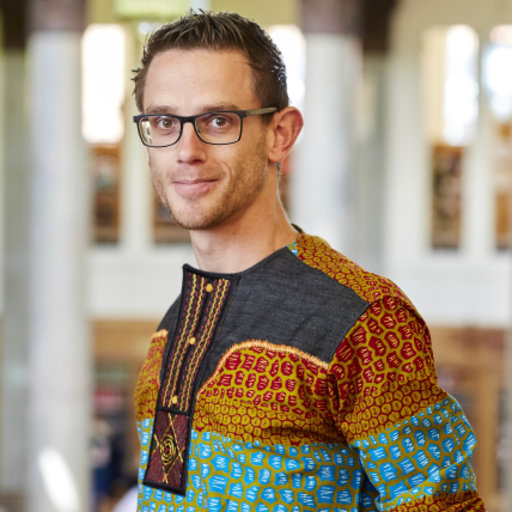
The African ethos has been seen to be broader than expressed in this statement. Works written by Adriaan Van Klinken voice an opposing opinion that you can check out. Adriaan Van Klinken is a Professor of Religion and African Studies at the University of Leeds has some interesting views we can consider.

  1. A lot of religious leaders see religion as being inclusive

He talks about the advocacy work of Bishop Desmond Tutu in this article, pointing out that while he faced some opposition from his colleagues he, and thought leaders like him, viewed homophobia, heterosexism and racism in the same light. In Namibia there are organisations that advocate for religious LGBTQ+ persons and their allies such as Tulinam.

 2. The Bible can be interpreted in a way that upholds Ubuntu

In a book he co-wrote with Ezra Chitando, Reimagining Christianity and Sexual Diversity in Africa, they explore a radical theology of inclusivity, where they unpack two myths. The first ‘myth’, commonly articulated in African nationalist discourse, both within the churches and in wider African society, is that homosexuality is a purely Western phenomenon, imposed on Africa by the ‘gay lobby’ and other international human rights advocacy groups, a product of neo-colonialism and neo-liberalism. The second stereotype originates in Western secular discourse, which often characterises Africa as intractably homophobic, fuelled by a regressive, pre-enlightenment version of Christianity.

 3. Homophobic attacks can be dehumanising to an extent of missing crucial lessons in Christianity

The human rights listed above also apply to LGBTQ+ people who are religious. In this article, he speaks about a wide array of effort against the LGBTQ mentioning how those who have been discriminated against in Uganda seek refuge in Kenya but are also subject to harrassment there. In the article he also talks about the documentation of lives of African LGBTQ+ people through art, one work he cites is a collection of stories titled Stories of Our Lives, wherein 250 stories are submitted by Kenyan people showcasing everyday human experiences.

Conclusion

A view of religion in Africa that is inclusive also promotes concepts that are central to Africa like Ubuntu. While neutrality and middle grounds are difficult in most instances, Adriaan van Klinken believes that room seems to exist for an interpretation of religion and the freedoms associated with it, which promotes togetherness rather than division and conflict.

Black History Month: Triumphant or Tragic in 2023?


Black holidays as I’ve known them have been hecticly traced with tragedy. Unfortunately, all the holidays I have experienced have to do with colonial suffering. This month, at my big age, I found out that a lot of people and institutes in Africa also celebrate Black History Month, something I thought was unique to the experiences of those whose ancestors survived the slave trade, another historic event characterised by Black people suffering. The month came after a long struggle to make sure that Black stories are never lost. I won’t get into the history of it too much, if you’d like a quick history, you can read about it here.

The slave trade and colonial era were undoubtedly an operation of the mass erasing of Black consciousness. A month dedicated to undoing this harm must have been a huge win, considering that the establishment of this this took place between 1970 and 1986 in a more openly and violently racist world. The first celebration kicked of on 2 January till 28 February 1970. Somehow this has moved down to just the 28 days of February and has been clumped up with LGBTQ+ month in the UK.

The decision to have Black History Month in February was in honour of the birth of President Lincoln who is credited for criminalising slavery , and the death of Fredrick Douglass a black former slave and abolitionist.

There is an implication around this that doesn’t sit well with me. Some sense of duplicity I feel when I think that the timing was based on the birth of a white man on a pedestal for admitting that “Black people are people too,” and laying it on the tragic death of a Black man who spent his life fighting to prove this fact and could not enjoy it almost to say ” Celebration for the black people comes throug suffering.” Maybe I’m being too pessimistic in may analysis but something about it highlights the current nature of many African holidays. That they are anchored on the deaths of Black people who died fighting for what they could not experience and exist in the shadow of more lighthearted holidays birthed by white people, like Christmas, Easter Day and April Fool’s Day. Sure we can be a part of the fun, but it is not a fun we designed, it was given to us, and when it’s purely about us, it’s about how much suffering we have apparently overcome.

Maybe I’m just drawing at strings here, but, while I see how Black History Month is worth celebrating, I find it difficult to think of it as less than sad in 2023. If not celebrated, it dismisses efforts put in by Black advocates and activists, if celebrated with full glee then it disregards the fact that this is the bare minimum and that we need to uplift the value of more culturally appreciative holidays. A lot of whitewashing needs to be undone, and many generations have grown with the view that indigenous holidays are ‘evil’, that the bare minimum and assimilation are better than carving out an identity. Let us never forget those who struggled to get us to where we are, and let us move on to honouring who we are. Even if a customary group viewing a holiday is less than a dozen, I still say its better to sing in the joys of the practices that have shaped us, to contribute to the evolution of tradition, rather than to watch customs die and forever sing of the times we suffered like we had no joy.

With that said, happy Black History Month…