

Section 6 of the Swakopmund Protocole
The owners of the rights shall be the holders of traditional knowledge, namely the local and traditional communities, and recognized individuals within such communities, who create, preserve and transmit knowledge in a traditional and intergenerational context in accordance with the provisions of section 4.
The application of this section is partially significant for how it allows customary groups to take ownership of their stories. The colonial era had oppressors taking the role of the authority on people’s stories. While we remain grateful for education, we can’t neglect the messaging that, “foreign knowledge is superior to indigenous knowledge.” This has played out as indigenous people not often being at the forefront of being historians of their own cultures. Since independence, many cultural groups have been making efforts to correct the stories that have been told about them. In this article we’re covering two works that have been conducted in Namibia, surrounding the cultural relationship between people and the ocean.
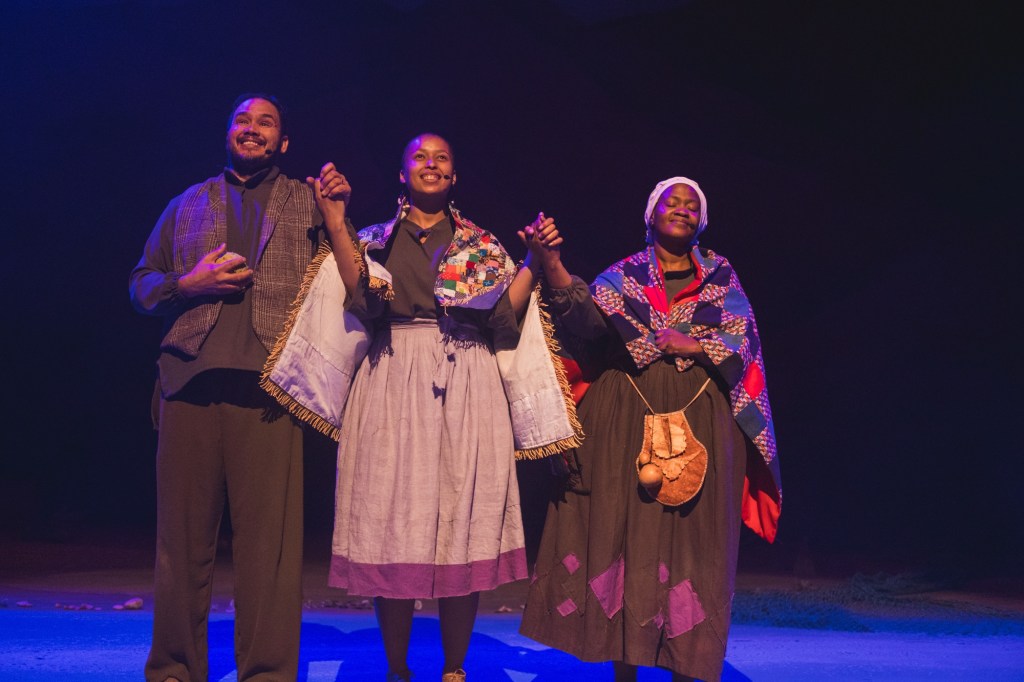
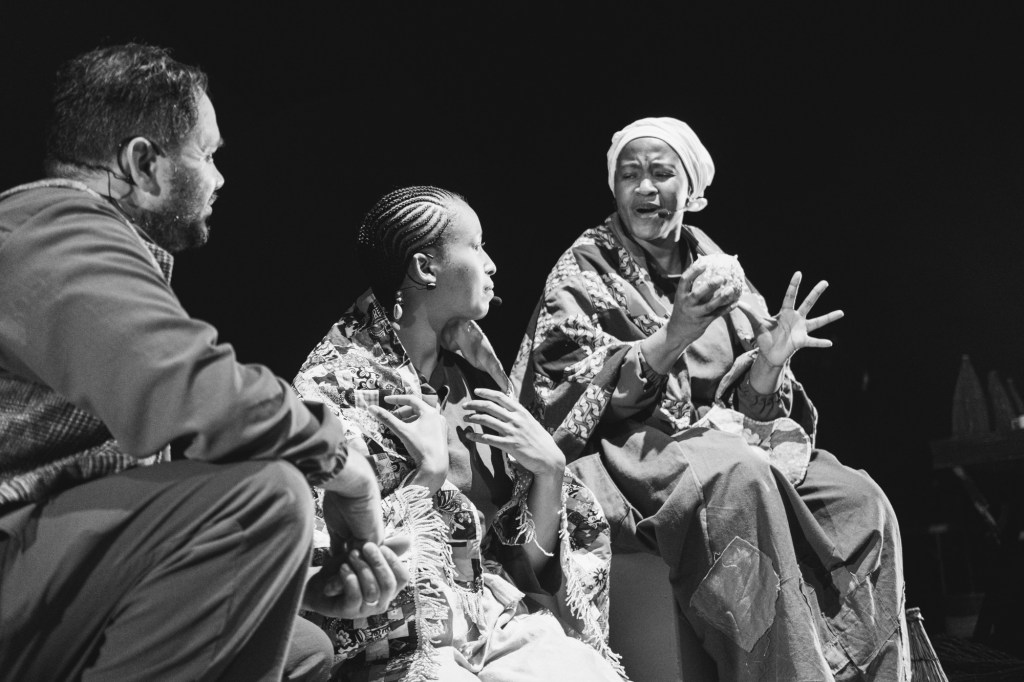
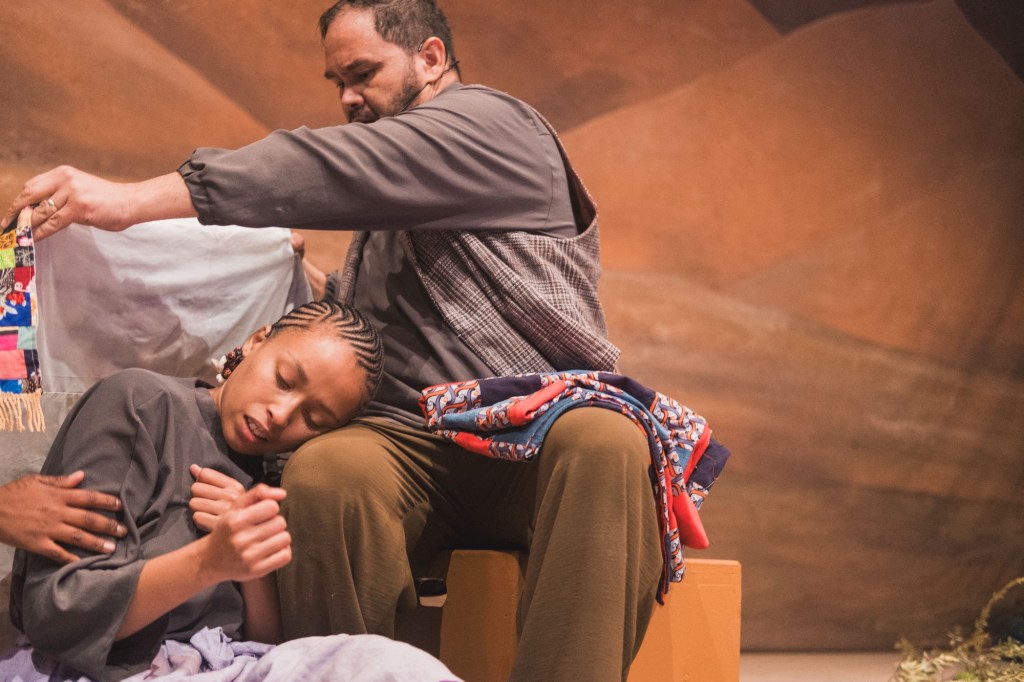
A phenomenal production retelling the story of the ǂAoni people and the ocean. The play consists of a cast of three, the father (Dawie Engelbrecht), the mother played by Hazel Hinda and their daughter Khoendikhoes, played by Chantell Uiras (Diolini). The story follows the three as they revisit the events of the colonial past and how these impacted on the current socioeconomic position of the ǂAoni people, a clan of Nama people mostly found around the !Kuiseb river in the Erongo region also referred to as the Topnaar community.
Setting things straight
One of the main issues covered in this play is that of the history of the community. Colonial era historians alleged that the community’s displacement during the colonial era was in response to countering fighting within the community and harm to the natural environment. The story starts by letting us know who these people were recognized as, ‘the water people’ or guardians of the water and marine life. Their role as caretakers was undermined by the ambitions of the colonizers. It was also clear that they were moved without consultation and that it was carried out in a forceful and chaotic manner. They did not stand a chance against the armed invaders and had no other choice but to comply. An all too familiar history. Before anyone else felt the hit of the colonial invaders, they, being at the coast, felt the first and strongest blows, and because the settling of foreign invaders on the coastal territory did not help their case much.
They spoke of the !Nara fruit (Acanthosicyos horrida), how it was not just food, but the unique way in which each family farmed it was a way to distinguish between families. After the displacement, restoring the practices that were central to their cultural identities has been a struggle not so much because they have lost the capacity to do so, but more because of the policies put in place to make sure that they never do Policies that have seen their way into post-independence Namibia. The play was not made out to be an attack on the contemporary government, but a channel to shed light to the fact that they (the Topnaar community) too are a people that were uniquely disempowered by the apartheid system, and that their story continues to be swept under other emerging and apparent issues. The story has been written in collaboration with academic research institutes like the University of Namibia (UNAM), One Ocean Hub, Global Research Fund, and UK Research and Innovation. Researchers such as Robert Vigne are also amongst those who have showcased the significantly disproportionate level of harm faced by the Topnaar Community during the colonial era. It’s safe to say that the message shared is one grounded in facts not a baseless critique.
When speaking to the audience after the play, a leader from the ǂAonin community, Joel Kooitjie, as well as, acting chief of community Stoffel Anamab, pointed out the struggles that their people continue to face today. Some impacts include the fact that they are only about two Topnaar people in local authority offices and that decision makers in their area can sometimes fail to capture their context very well and ultimately miss their needs. Furthermore, as a community that had largely survived on marine life for sustenance, bearing witness to the harm the ocean and its creatures have faced while disempowered from taking any feasible steps to help serves as a testament to the gradual weakening of their own development, this is in part because a great amount of their income came from inland circulation of oceanic goods. The historical and cultural relevance of ocean governance in this community has been significantly undermined and resulted in having to re-adapt to a life where their strongest skills remain in the backburner. It goes without saying that this need to suppress who they are in order to be convenient for invaders is a level of robbery that digs at the core of personhood.
Conclusion
The play ǂAONI //AES is an example of the Swakopmund Protocole at work. It’s the active reclaiming of a history by the people. It is also an assertion of who they are and who this land has known them to be. The impoverishment and struggle they face today is a result of being subject to a system that has unfortunately kept them down. The post-colonial government canntot take the blame for this, but, in their continuous efforts to decolonize Namibia, they can take the Topnaar Community and their pleas into consideration.



 ZENZE
ZENZE 