WHUDA: Preserving the art of Stonemasonry 

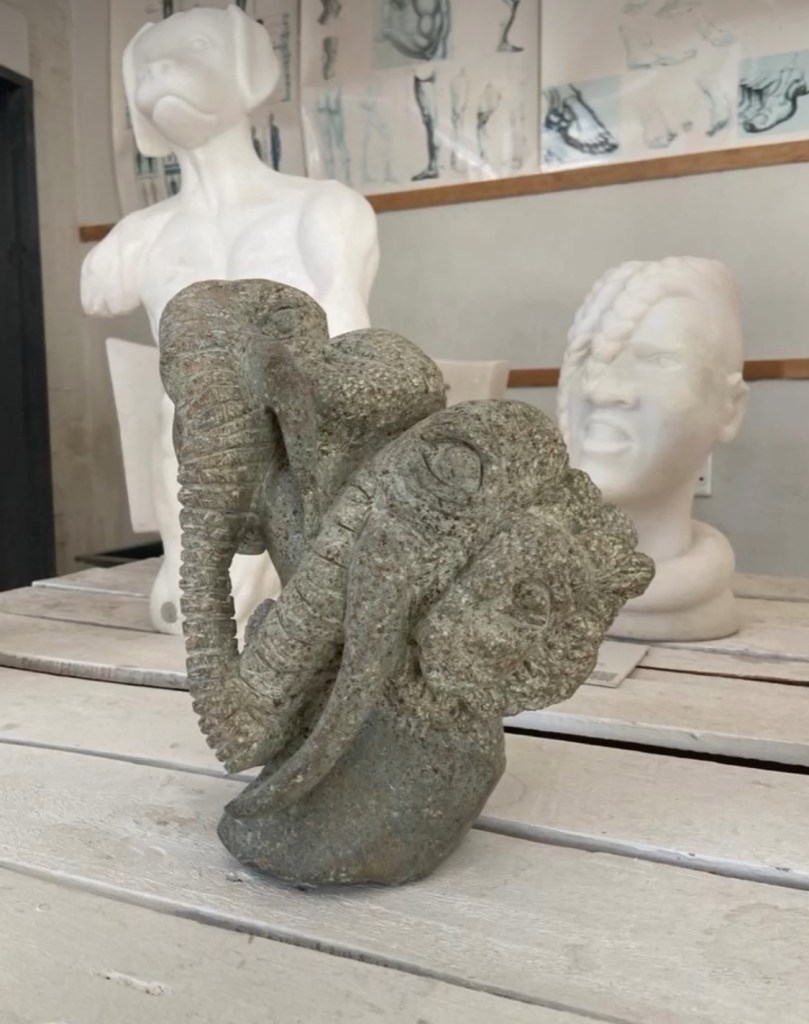
Stonework by Rivaldo Diamoh Sithole of WHUDA

WHUDA  (Winfried Holze Urban Design Architectures) a marble artworks studio which was started by Winfried  Holze in 2018. It has since become one of the few marble arts companies actively preserving and transferring the art of stonemasonry. 

Stonemasonry has, in the past decade, been cited as being amongst the fading forms of indigenous knowledge in Southern African countries. The Great Zimbabwe Museum, with the support of the Endangered Material Knowledge Programme, has been particularly focused on conserving the knowledge around dry stone masonry and encouraging a movement to reinvigorate the practice. It is an understatement to say that patronising this craft is a positive step in cultural appreciation.

The WHUDA team not only preserves this craft as artisans but they extend this skill to explore contemporary social narratives as well. 

On the 6th of March 2025 the National Art Gallery of Namibia will be hosting WHUDA in an exhibition titled “Earth to Light” and the possibility of seeing some great works while exploring some insightful themes is palpable. The team’s recent works include an exhibition during KIFA Week 2024 (Kalahari International Festival of Arts), where the WHUDA team showcased works inspired by cultural integrity and mental healthcare which are very crucial subjects in our globalised world. Their latest work, “Silhouette Evolution” was a multidisciplinary event which portrayed the potent role of stonemasonry in contemporary arts and culture. Here’s a dive into that event;

Silhouette Evolution: Stonemasonry on perception and transformation 
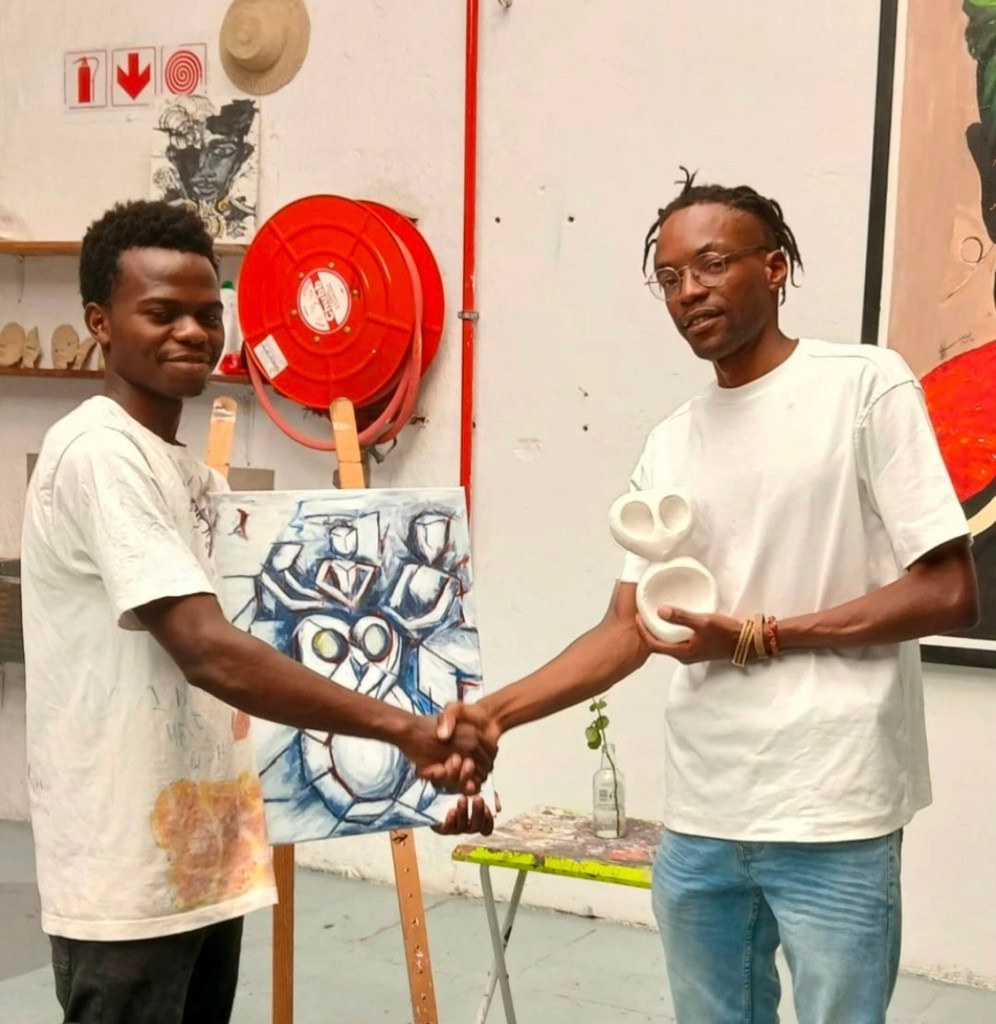
William Tonderai (Left) and Ino Ati the painter (Right)

On the 25th of January 2025, I had the exciting experience of attending the Silhouette Evolution live session by William and Ino Ati. A silhouette is an image often in a single hue and tone against a brighter background, usually a black shadow against a white backdrop. Evolution has to do with the gradual development of something. This event made use of these concepts to explore perception and transformation.

This was the scene of the event; a painter painting the image of a sculptor who was in the process of sculpting while the audience dipped in and out of observing that process. Going to add their strokes on two group paintings that were in the next room, having conversations and drinks or playing a game of pool. Meanwhile, the stone being carved, the reason we were all there, was going through its transformation amid all these activities. 

This event  was without a doubt, an insanely creative way to explore the nature of transformation. That the world doesn’t stop to watch you change and grow, you just do as the world goes on, so that Pinterest quote saying “Stop waiting for the right time, and just start working on being who you want to be” has some truth to it. 

One of the collective paintings the audience worked on, led by Shamoulla

In terms of perception, it seemed, the idea of a silhouette captures this very well. Fundamentally “what is your single hue image as everything else falls in the background?” and that “simply because it’s not the center of your perception doesn’t mean it loses value or ceases its own evolution” (your main character is not the only main character).

The event masterfully showcased three ideas associated with perception;

  1. That it is uniquely held;  different people may look at the same things yet walk away with different ideas of it.
  2. That to be perceived is not a requirement of transformation.
  3. That what we perceive to be of highest importance is often what shapes our experiences.

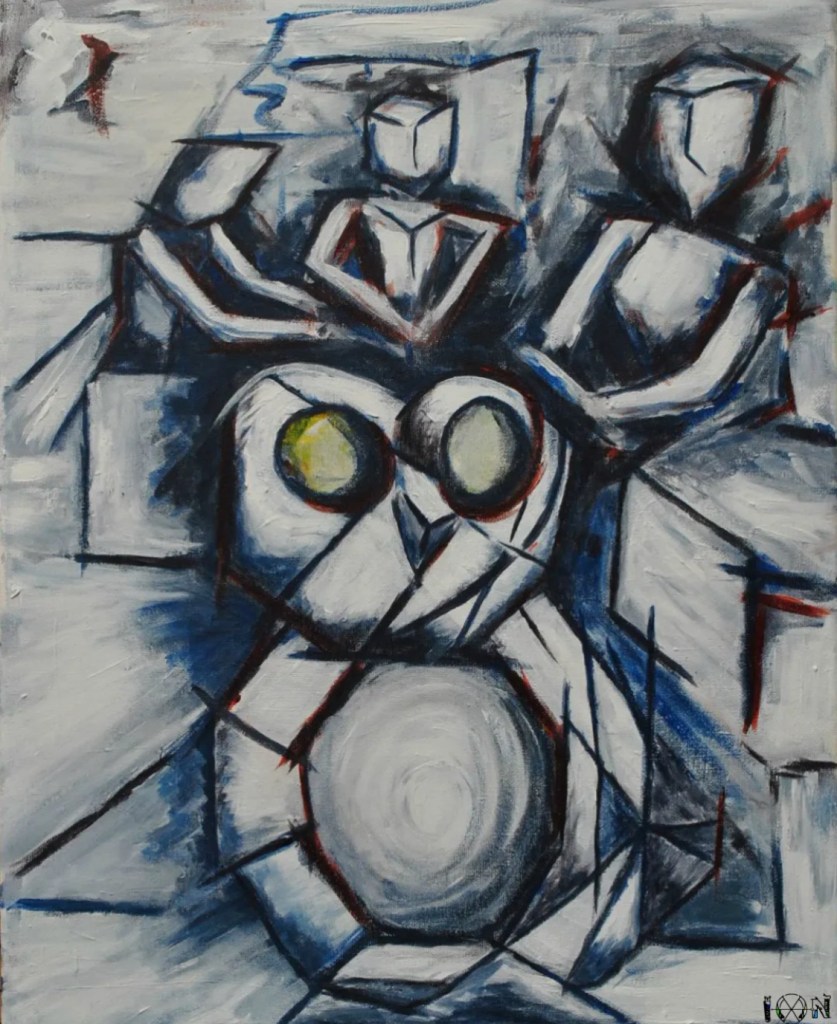
While the audience simply watched a man turn a rock into a rock shaped like an owl. The painter created a much more dynamic image,capturing the sculptor’s movements while centering the owl with yellow eyes emerging from a block of marble. I mention the stonework as being at center stage, but, gathering from the painting  titled “The sculptor’s nest”  it could easily be the sculptor’s immense focus around all the movement and noise that could be said to be the crowning piece of the event, or the painter’s creative eye and craft in his portrayal of the transformation taking place in front of him that were the event’s masterpieces, or the paintings in the next room that the audience passively worked on together with less attention given to them until the sculpture was done. Or someone could’ve walked away remembering the owl in the painting and how it’s yellow eyes were watching us, and the guys playing pool could be looking on the day they had a great game of pool which stopped because it rained.

Ultimately, the title Silhouette Evolution perfectly captures this idea of a fantastic transformation taking place in the background. The question of which fantastic transformation takes the forefront depends on the viewers perspective, at the same time, that single perspective doesn’t lessen the value of the other transformations taking place. 
William at work
Close Up of the Sculptors Nest by Ino Ati

Conclusion

Go visit the exhibition on the 6th of March 2024 at the NAGN to experience WHUDA artworks. The Silhouette Evolution is only one of the many means of storytelling and exploring of concepts that the WHUDA team has participated in. As they continue to contribute to the preservation of stonemasonry as an art form, their creations and the narratives they explore effectively document the times in culturally specific forms, while having the potential to address several contemporary issues.
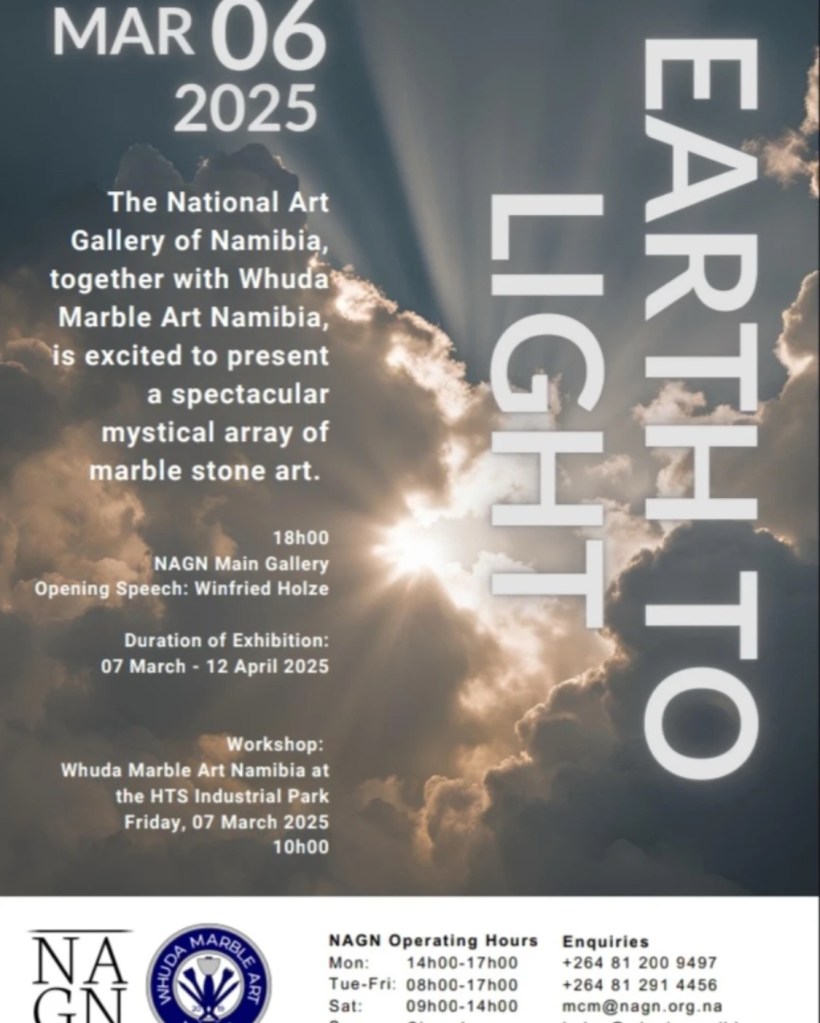
Earth to Light Exhibition Poster

Reach out;

WHUDA: 

Instagram: @whudamarbleartnamibia

Website : http://www.whudamarbleart.com

Ino Ati (Painter of “The sculptors nest”) : @by_ino_ati (instagram)

Shamoulla (Coordinator of the group paintings): @shamoulla_creating (instagram)

The Story of Zuva and Mwedzi

In the spirit of romance, love and union, I decided to revisit an old folktale I came across some year back about how the world came to be. For a good while, I believed that this was the Shona, world creation story. I’d later find that there were different versions of it, all written with the bold claim of being the single story of how the Shona lore described the creation of the world, each with the same characters, Musikavanhu/Nyadenga (God), Zuva (the Sun), Mwedzi (the moon), Hweva (Morning star) and Morongo (Evening star). 

This story I’ve shared is a blend of all the versions I’ve encountered, enjoy ❤ …

This story goes…

Many years ago, before the great hammer hit the ground and before the world came to be, there was Nyadenga, who sat in constant contemplation. A moment came when he decided to move, in this moment he felt a great joy followed by an intense desire to share this experience. So he created to Zuva, full and fiery with a portion of Nyadenga’s greatest sense of passion and joy. 

After a time, it became clear that Zuva could not relate to Nyadenga, he had a loneliness about him which saddened Nyadenga. On a certain day, Nyadenga shed a tear at the sight of a lonesome Zuva, who’d been yearning for something he’d never known before. Nyadenga kept this tear and breathed life into it. Giving birth to Mwedzi, a companion for Zuva.

The two shared a beautiful romance, and Nyadenga delighted in it. He gave them the ability to realize this love through creation. Together they were amazing creators, Zuva would create beautiful plants and vegetation and show them to Mwedzi, and Mwedzi would create insects, birds and many gentle animals to show to Zuva. The more they created and shared in the beauty of their creations, the more their love grew. Nyadenga had been gifting them with inspiration when they created and stoking their love when they were apart, it gave him a sense of whimsy to do this for them in secret, and the amusement he felt when they’d each come and talk about the other in their private times with Nyadenga, filled him with more gratification than he’d ever anticipated.

Gradually, they grew more and more distant from Nyadenga, relishing only in their union. No longer speaking to their creator, leaning into a vanity over the works they had done.

Nyadenga grew furious at this, after all, the entire reason he created them, was to share the joy of life with them.

He watched as their vanity transformed their love into arrogance, believing they had done it all on their own. He leaned further back when they no longer sought to create as a mark of affection and their once heartfelt devotion to each other turned into competition. 

Their new commitment to outshine each other increasingly became fuelled with spite. Each one determined to prove that their creations were more beautiful, more important, more useful than the other. 

In a moment of rage, Zuva, knowing that Mwedzi’s animals fed on his plants, began to lace some with poison, and sure enough, the animals began to die off. A grief stricken Mwedzi, not knowing how to deal with this deception grew angry at her creations, she had often bragged that her animals were stronger because they could move freely as they pleased and that she could easily command them to stomp on Zuva’s motionless plants if she wished. She never imagined that he would poison them, or that they could succumb to the attack of a motionless creature. Soon after she created more violent animals to hunt down and kill the ones that had embarrassed her. 

This war that grew between Zuva and Mwedzi was felt by their creations. The plants vowed never to speak, fearing their father would set them ablaze. The herbivorous creatures grew more anxious, and uncertain, not knowing why they were punished with such violent siblings. And the carnivorous animals turned on each other, those who revelled in their roles as predators making a sport of attacking those who had sunken into shame and guilt for their violent nature.

Nyadenga could no longer bear the chaos. He called Zuva and Mwedzi and showed them the pain they had been causing. But they were too caught up in their strife to truly care about the harm they were causing to their creations, only choosing to blame each other.

So one day, Nyadenga took from Mwedzi’s smaller carnivores, the snake, which at the time only hunted for mice, and he filled it with poison from one of Zuva’s plants and set it loose. As Zuva paced and inspected his garden, he grabbed this snake with careless rage, mistaking it for a fallen branch and it’s hiss for an expression of disrespect, he had believed the plants honoured him with their silence. 

He felt the poison shoot up and without much time he was with Nyadenga.

Mwedzi would meet a similar fate, when she grabbed the snake to return it closer to the mice after seeing it wonder near Zuva’s garden.

The two pleaded with Nyadenga, begging to be sent back, Nyadenga wouldn’t have it, but he allowed each of them a single ask for their eternal lives in Nyadenga’s house. Mwedzi begged for them to be able to watch over their creations. Nyadenga granted this with the condition that they never do this together, that they were to spend eternity watching over their world apart, and were to never directly interact with their creations as they did before. 

After hearing that their union would not continue in eternity. A teary eyed Zuva begged for a chance to work on one last creation with Mwedzi, as a monument to their love. She accepted this, it hurt her too that their relationship would end, even though it had become so bitter. Together, with the help of Nyadenga they spent time creating mankind and womankind, pouring bits of themselves and their shared love and knowledge into them, and placed them on earth to help keep harmony amongst all creatures.

Soon after they were done, they shared a final kiss and a teary farewell then Nyadenga kept his word and separated them. Calling Zuva’s watch time day time and  Mwedzi’s watch time night time.

They drew nearer to Nyadenga, in their separation and the love that they had shared for each other resurfaced. So Nyadenga, not wanting them to suffer the lonesomeness that had once caused a heartbreaking isolation in Zuva, allowed them to send messengers; Hweva and Morongo, between each other, while keeping the vow that they never meet again.

The End

Global Africanism and the African Renaissance

The  African Renaissance is taking place and through it we are fortunate to be at the forefront of seeing Africa take her place in the world. There are ongoing efforts at decolonising several industries, reclaiming narratives as well as embracing and contextualising  cultures. The idea of  Global Africanism looks at where Africa finds herself during this transformative era and how she interacts with her global peers. 

The term was popularised in an edition of the General History of Africa project which was introduced by UNESCO in an effort to support Africans reclaiming their narratives. The purpose of the Global African movement was to bridge the militant goals of the Pan-African movement with the diplomatic efforts of international bodies such as the AU and the UN. On one end, making PanAfricanism fit global diplomacy standards has been seen as a form of giving up and folding over to forceful powers, with leaders such as Malcom X fervently urging his followers to remain distrustful when it came to diplomatic approaches to conflict resolution. On the other hand it is the diplomatic approaches of leaders such as Nelson Mandela, that helped translate PanAfrican goals and get state freedom.

In his 2019 paper A call for a ‘right to development’- informed pan-Africanism in the twenty-first century, Kamga discusses how the rest of the world can take part in the African Renaissance particularly in the realisation of the right to development. That way, he essentially incorporates Global Africanism in his arguments. Outlining how international tools created to maintain diplomatic relations, can be useful pathways for development only if Pan-African goals are centralised rather than the neo-colonialist outcomes that many African countries have become subjected to. This right  is  outlined in Article 22 of the 1981 African Union Charter, the basis of the 2001 New Partnerships for Africa’s Development program by the Au as well as Resolution 41/128 of the UN General Assembly (the Declaration on the Right to Development) and is embodied in the 2030 Agenda for Sustainable Development.

In a 1998 speech Thabo Mbeki made a reference to the Japanese Meiji period when illustrating the possibilities of the African Renaissance, a time of industrialisation for the Japanese and successful resistance to being colonised. In this it’s made clear that  most important means of achieving this is building such an interest, especially amongst the emerging young Africans, to form united African nations, to learn and contextualise what’s working for others, all while maintaining cultural integrity.

Thabo Mbeki spoke a lot about the African Renaissance during his presidency, making clear his ambitions to bring South Africa to a level playing field with global superpowers. This ambition and vision stirred up hope for a much more successful South Africa, but in implementation, he faced criticism for placing so much focus on these diplomatic relations that he’d neglect meeting many South Africans’ immediate needs like employment for a great amount of the youths. That being said, Kamga’s approach seems to address what much of Thabo Mbeki’s approach missed. Voicing how the need to meet practical needs is an international objective that can still be met.

Global Africanism and the African Renaissance are PanAfrican concepts that, not only call for the imagination of a better future, but collaborative efforts to making that future a reality. Kamga makes it clear that the potential exists for everyone to take part in this. We’re one year closer to the Global Agenda for Sustainable Development’s vision 2030 and it’s exciting to see ideas that aim to make PanAfrican goals a reality.

I was born a girl Exhibition: Celebrating Human Rights, Women and Engaging Men in GBV Advocacy

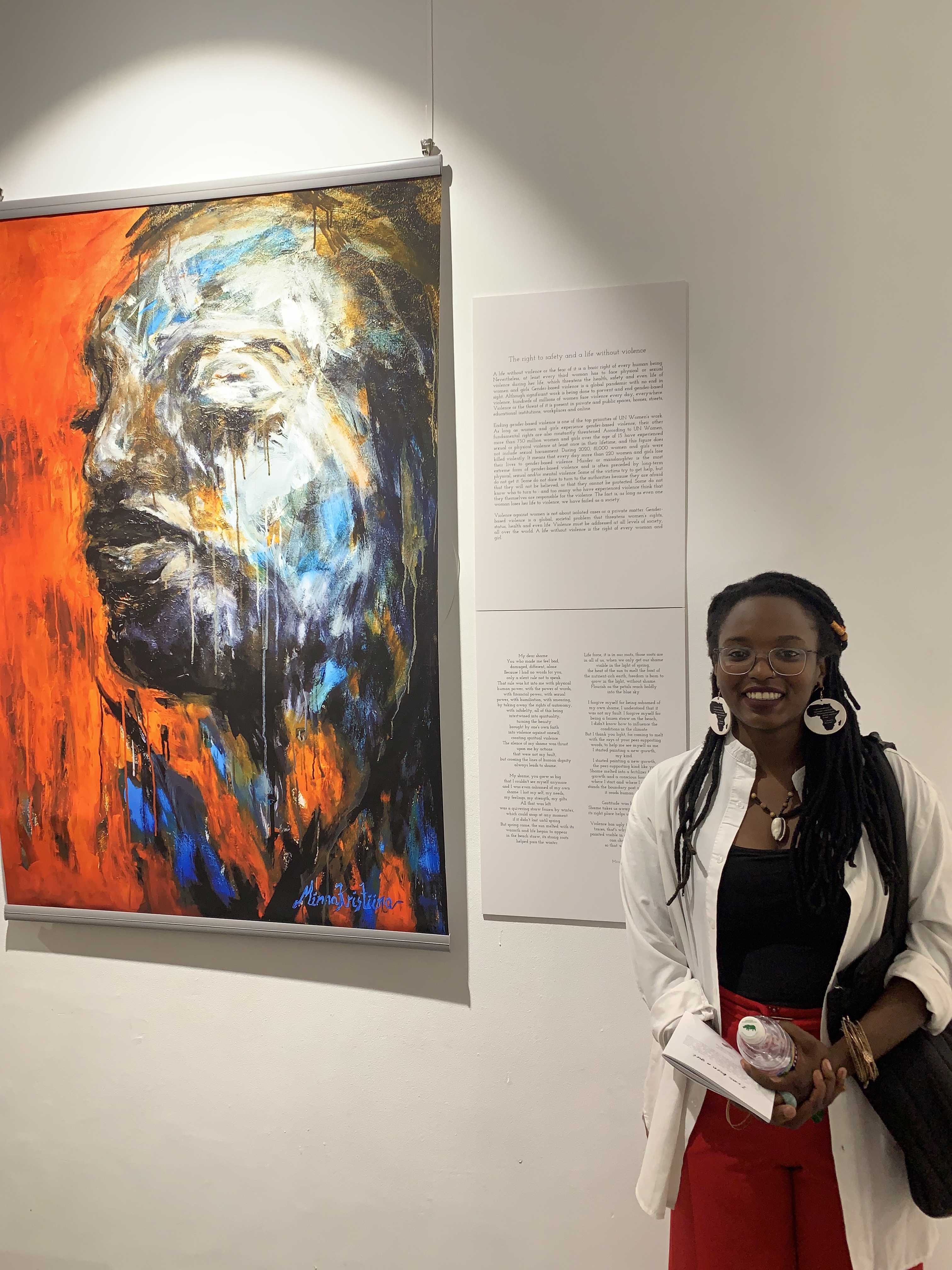
My interest in visual art has been in relation to how art brings about justice, transforms and documents culture and good old slice of life type of work. The work in the “I was born a girl” is a well timed reminder for women’s rights defenders to never lose hope. The exhibition was launched at the Goethe institute and HISA center, hosted by the Finnish embassy in honour of the 16 Days of activism against Gender Based Violence, taking place from the 24th of November to the 10th of December. I have no doubt that it was a worthwhile experience for anyone who appreciates art as a tool for justice. A project by Minna Pietarinene and Peppi Stunkel to highlight the incredible efforts of women’s rights activists and leaders from different parts of the globe. Each piece comes with a poem and corresponding human rights and their stories, succinctly capturing the efforts of some pretty awesome human beings.  

Here some highlights from this exhibition;

Context from Namibian Human Rights Advocates

The event was launched with a notable mindfulness for the context of where it was being launched. The work has been showcased in different parts of the world, including Mexico, South Africa, Mozambique and Switzerland and it’s great to see that the project takes into consideration the conditions and background of its destination country. Created with the notion that while human rights are for everyone, they are not a ‘one size fits all’ solution.

Often times when the subject of human rights comes up, the risk of westernization disguised as human rights, especially because of the consequences of not being vigilant about intentional or unintentional colonial imposition. The need to guard contextual narratives is often a top priority when human rights are discussed because too many instances have come up where irrelevant solutions are applied. During the launch of this event, a panel discussion was held which included speakers from The Legal Assistance Center Namibia, UNFPA Namibia, Sister Namibia and the One Economy Foundation. The conversation highlighted an existing frustration with inadequate implementation of laws in Namibia, the need to expand on civic education and men’s engagement with Gender Based Violence Advocacy in Namibia. In response to this, a male engagement event in honour of the 16 Days of Activism against GBV was held on the closing day of the exhibition at the HISA Center.  This exhibition was more than just a moment to appreciate some good artwork, it also provided a helpful platform to unpack men’s roles in advocating against GBV, the reality of having great written laws but not being able to use to rely on them, either as a result of people not knowing them well enough or regulators not always making use of them.

The Works, the Poetry and the Women

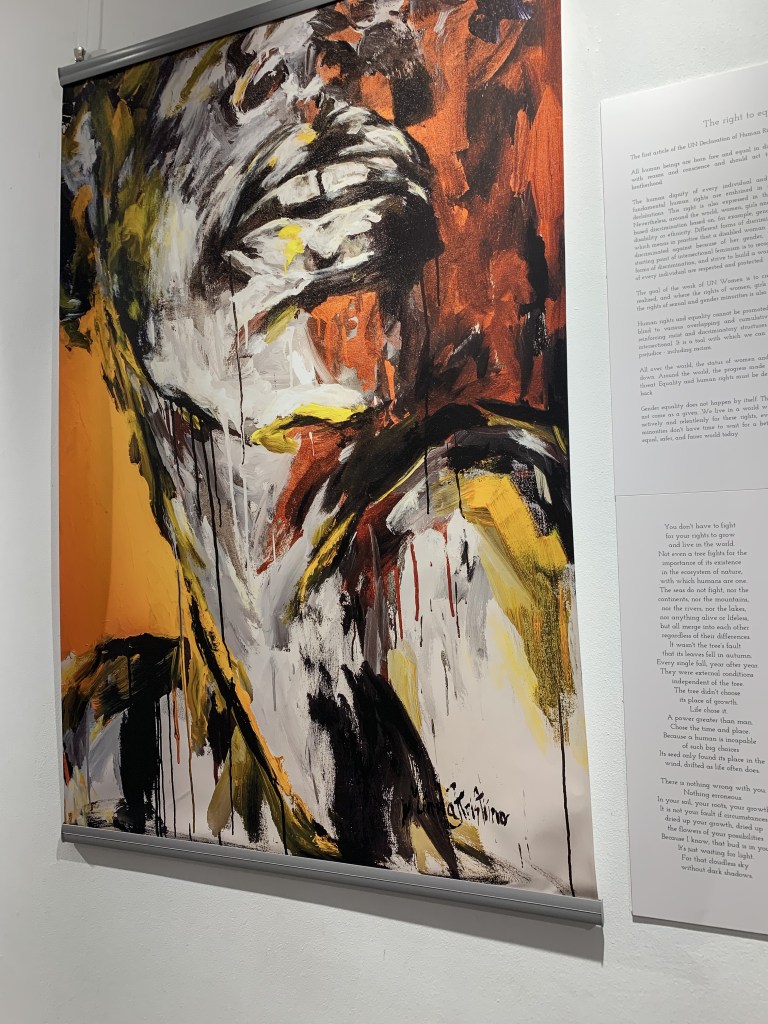
What makes the “I was born a girl” exhibition especially universal is that the collection includes diverse women from diverse communities, all bound by uniting rights and theme. The colour orange is present in all the pieces, the colour of the Unite to End Violence against Women Campaign which encourages people to wear orange to symbolize a future free from violence. It starts off with an overaching experience associated with human rights violations, shame. The piece titled “My Dear Shame” speaks on how isolating and overwhelming such experiences can be, and how human rights are protective boundaries that make room for love, and how these rights can bring about positive change. The right emphasized in this piece is the right to safety and a life without violence. Other works include stories of women who intenetinally went into the profession of politics and the protection of human rights such as Sanna Marin the former Prime Minister of Finland who advocated for the right to non-discrimination. Women who inadvertently fell into advocacy by unapologetically pursuing their passions, such as Alcenda Panguana and Rady Gramane who became symbols for the right to gender equality in sports after challenging stereotypes in boxing. Women whose efforts as community workers highlighted rights violations, such as Zanele Mbeki whose commitment to social work resulted in her significantly addressing the right to economic empowerment.

The I was born a girl exhibition ran in Windhoek from the 13th to the 19th of November 2024 at the Goethe Institute and from the 20th to the 27th of November 2024 at the HISA Center. To learn more about this work, visit www.iwasbornagirl.fi .