ǂAONI //AES : Reclaiming the Historic Narrative of the ǂAoni People Through Theatre

Section 6 of the Swakopmund Protocole

The owners of the rights shall be the holders of traditional knowledge, namely the local and traditional communities, and recognized individuals within such communities, who create, preserve and transmit knowledge in a traditional and intergenerational context in accordance with the provisions of section 4.

The application of this section is partially significant for how it allows customary groups to take ownership of their stories. The colonial era had oppressors taking the role of the authority on people’s stories. While we remain grateful for education, we can’t neglect the messaging that, “foreign knowledge is superior to indigenous knowledge.” This has played out as indigenous people not often being at the forefront of being historians of their own cultures. Since independence, many cultural groups have been making efforts to correct the stories that have been told about them. In this article we’re covering two works that have been conducted in Namibia, surrounding the cultural relationship between people and the ocean.

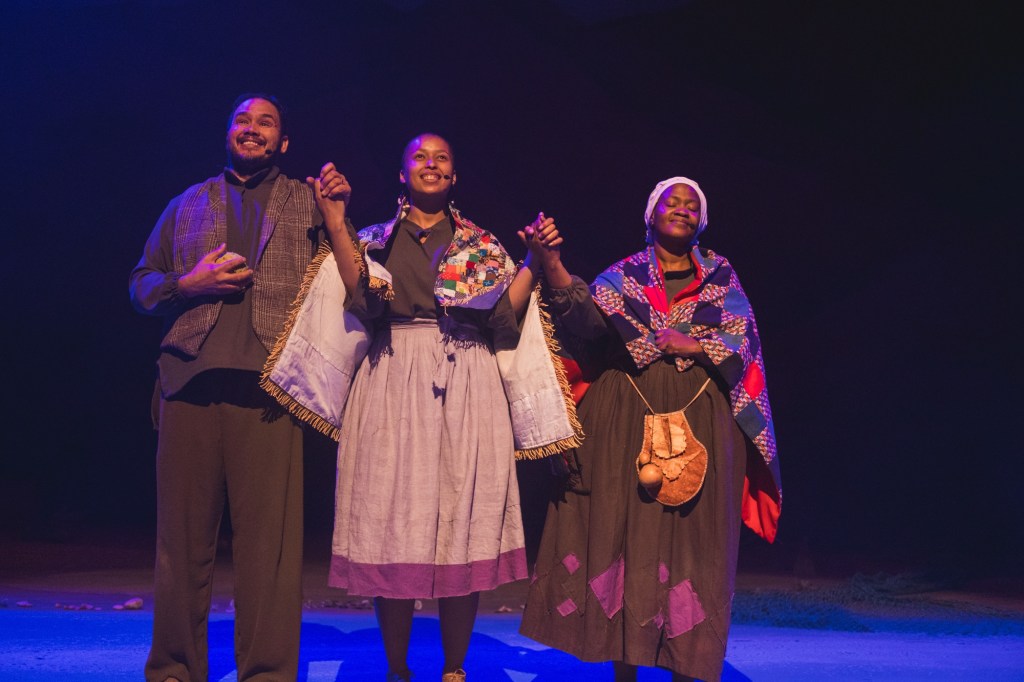
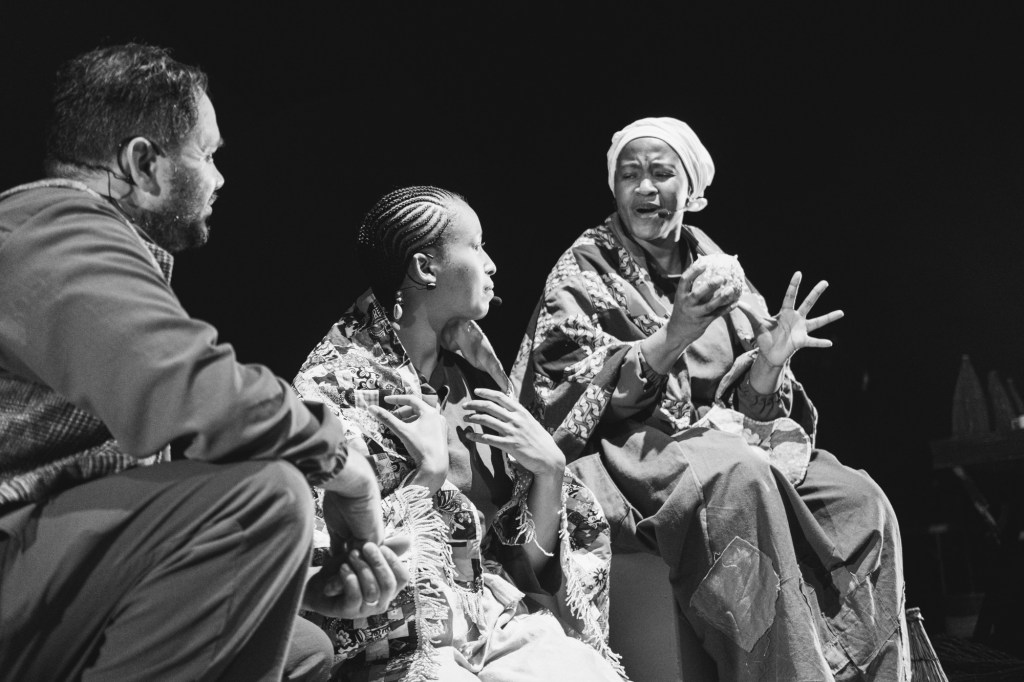
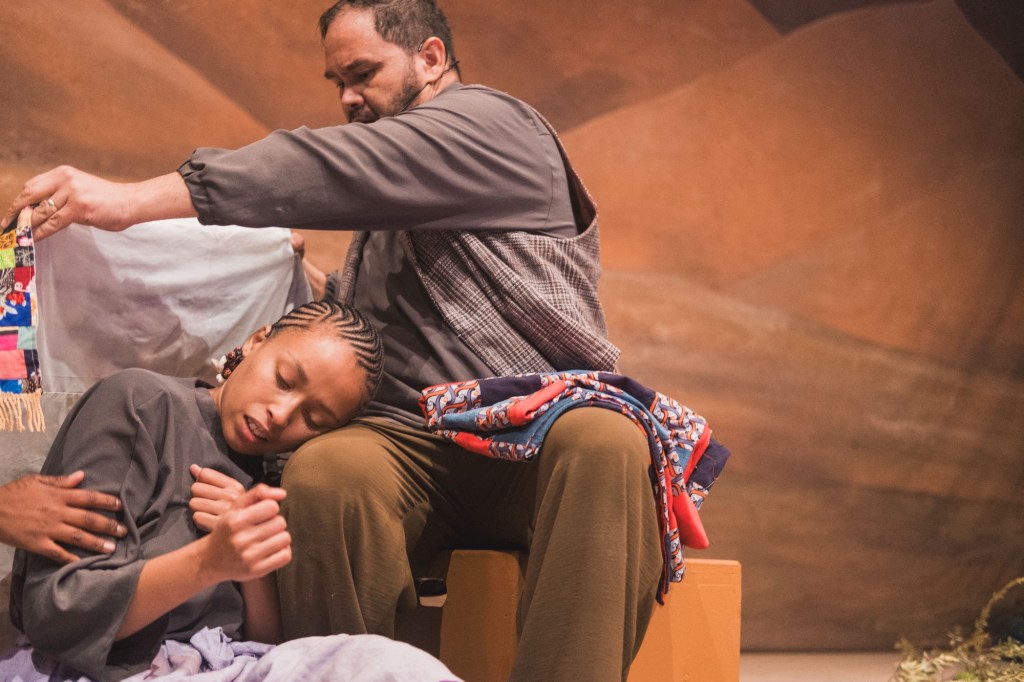
A phenomenal production retelling the story of the ǂAoni people and the ocean. The play consists of a cast of three, the father (Dawie Engelbrecht), the mother played by Hazel Hinda and their daughter Khoendikhoes, played by Chantell Uiras (Diolini). The story follows the three as they revisit the events of the colonial past and how these impacted on the current socioeconomic position of the ǂAoni people, a clan of Nama people mostly found around the !Kuiseb river in the Erongo region also referred to as the Topnaar community.
Setting things straight

One of the main issues covered in this play is that of the history of the community. Colonial era historians alleged that the community’s displacement during the colonial era was in response to countering fighting within the community and harm to the natural environment. The story starts by letting us know who these people were recognized as, ‘the water people’ or guardians of the water and marine life. Their role as caretakers was undermined by the ambitions of the colonizers. It was also clear that they were moved without consultation and that it was carried out in a forceful and chaotic manner. They did not stand a chance against the armed invaders and had no other choice but to comply. An all too familiar history. Before anyone else felt the hit of the colonial invaders, they, being at the coast, felt the first and strongest blows, and because the settling of foreign invaders on the coastal territory did not help their case much.

They spoke of the !Nara fruit (Acanthosicyos horrida), how it was not just food, but the unique way in which each family farmed it was a way to distinguish between families. After the displacement, restoring the practices that were central to their cultural identities has been a struggle not so much because they have lost the capacity to do so, but more because of the policies put in place to make sure that they never do Policies that have seen their way into post-independence Namibia. The play was not made out to be an attack on the contemporary government, but a channel to shed light to the fact that they (the Topnaar community) too are a people that were uniquely disempowered by the apartheid system, and that their story continues to be swept under other emerging and apparent issues. The story has been written in collaboration with academic research institutes like the University of Namibia (UNAM), One Ocean Hub, Global Research Fund, and UK Research and Innovation. Researchers such as Robert Vigne are also amongst those who have showcased the significantly disproportionate level of harm faced by the Topnaar Community during the colonial era. It’s safe to say that the message shared is one grounded in facts not a baseless critique.

When speaking to the audience after the play, a leader from the ǂAonin community, Joel Kooitjie, as well as, acting chief of community Stoffel Anamab, pointed out the struggles that their people continue to face today. Some impacts include the fact that they are only about two Topnaar people in local authority offices and that decision makers in their area can sometimes fail to capture their context very well and ultimately miss their needs. Furthermore, as a community that had largely survived on marine life for sustenance, bearing witness to the harm the ocean and its creatures have faced while disempowered from taking any feasible steps to help serves as a testament to the gradual weakening of their own development, this is in part because a great amount of their income came from inland circulation of oceanic goods. The historical and cultural relevance of ocean governance in this community has been significantly undermined and resulted in having to re-adapt to a life where their strongest skills remain in the backburner. It goes without saying that this need to suppress who they are in order to be convenient for invaders is a level of robbery that digs at the core of personhood.
Conclusion

The play ǂAONI //AES is an example of the Swakopmund Protocole at work. It’s the active reclaiming of a history by the people. It is also an assertion of who they are and who this land has known them to be. The impoverishment and struggle they face today is a result of being subject to a system that has unfortunately kept them down. The post-colonial government canntot take the blame for this, but, in their continuous efforts to decolonize Namibia, they can take the Topnaar Community and their pleas into consideration. 
How the Pride Movement in Namibia Is Fighting Colonial Laws

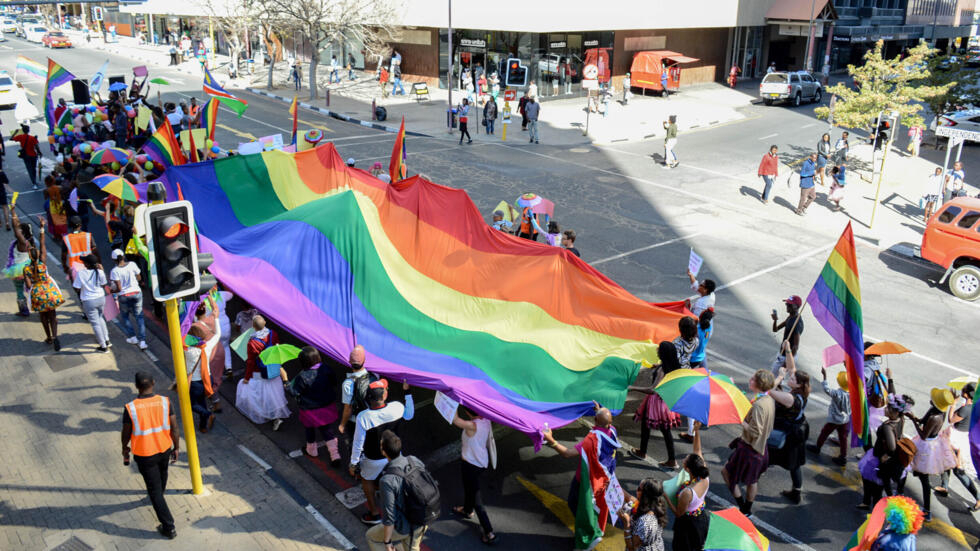
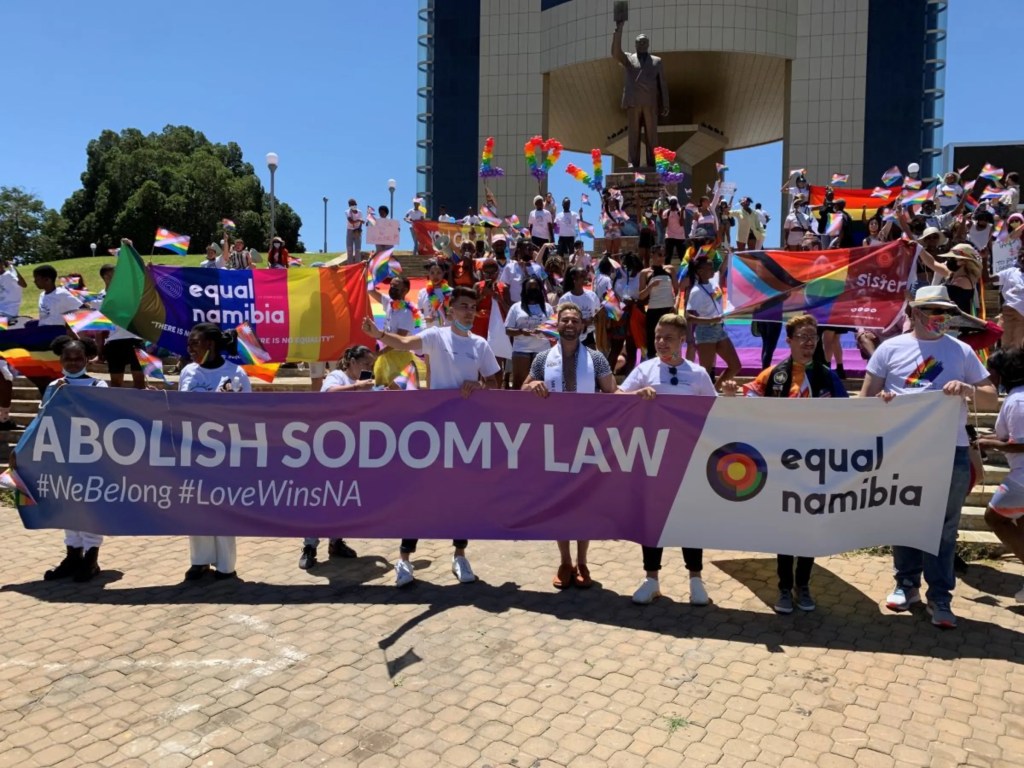
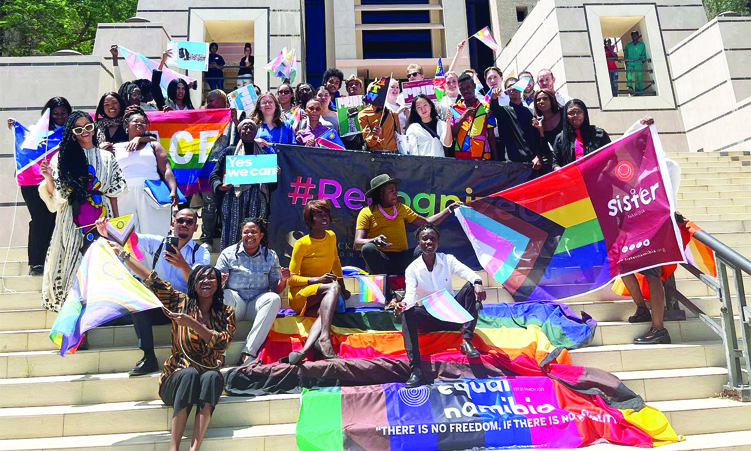
On the 21st of June 2024 the High Court of Namibia ruled in favour of declaring the sodomy law unconstitutional in the case of Dausab v the Government of Namibia. This follows years of activism alongside a steadily rising amount of homophobic attacks and an Anti-Gay Bill. We are in a pride revolution and here’s why its an important step against colonialism and genocide…

What does this have to do with colonialism?

Before colonialism, being gay was a norm. This sounds like a taboo to many who have fed into the false idea that tradition justifies homophobia. In many African countries, the word “gay” was normal enough to acquire its own title. For example; Eshenge in OshiWambo, Ngochani in ChiShona and Adofuro in Yoruba.

In the Namibian Ovambo cultural context it was believed that these men simply possessed a feminine spirits and were regular members of the community rather than ostracized minorities. German anthropologist Kurt Falk confirmed this during the 1920s having spent time with several Namibian tribes, including the Ovambo, OvaHerero, Nama and Himba. Ethnologist, Carlos Estermann supported this during the 1970’s and added that it was a culturally acknowledged ‘third gender’. The very first anti-homosexual trial was conducted under the German colonial rule. Four German men were banished for having defied paragraph 145 of the German Code which outlawed sodomy. This outlawing of sodomy was carried on by the South African colonial regime after taking over Namibia as a protectorate. If it isn’t already clear, the anti-homosexual laws were not born of tradition but of colonialism.

Over time, the colonial effect of self-rejection (a phenomenon whereby subjects to colonialism consciously reject colonialism but have learned to look down on their ethnic origins, cultural groups, cultures and customs) included a rejection of the LGBTQ+ community. Colonialism left in its wake, many with the idea that “all are equal but some more equal than others.” In our context, this idea from George Orwell’s animal farm wasn’t limited to just financial pursuits, but to the pursuit of love and happiness as well. A 2013 baseline study revealed that about 73% of nmaibians were under the impression that members of the LGBTQ+ community were accorded equal rights. This has not been true since the pre-colonial era. It has since become more evident that many are more aware of their own rights than those of others. So when words like moffie  are blurted out in the same tone as the word nigger or kaffer , it is easy to play it off as common rhetoric despite the fact that such terms are intended to humiliate and undermine an entire group of people for natural differences that they have no control over. Worse still, many have used these rhetorics and the laws supporting them to justify their violence and hatred, and further to pervert religion to suit these hateful narratives in the name if dispensing justice for God’s wrath. But that’s another conversation. In short, the same way colonial laws emboldened racist attacks, is the same way anti-homosexual laws embolden homophobic attacks. The same way racism was rationalized to seem like something morally acceptable, is the same way homophobia is rationalized to seem like the more morally acceptable stance. It is not.

The Dausab v Government of Namibia Judgement

Fortunately many LGBTQ+ people and allies have taken a stand against these senselessly exclusive laws. Everyone should have the opportunity to freely pursue romantic relationships. Human rights are a core aspect of the Namibian Constitution and are found in Chapter three. These have been developed with various religious and ethical concepts in mind, with the goal of ensuring that the law treats us all fairly. That we treat each other fairly.

The court in this case had to deliberate on three issues that relate to this;

  1. Whether the sodomy law violates the right to equality (Article 10(1))
  2. Whether the criminalization of same-sex relationships between men serves a justifiable purpose
  3. The balance between the interests of society and the interests of gay men

A few interesting points came up during the discussion that led to the decision that the sodomy law is unconstitutional. These are that;

  1. If the same act takes place between men and women, it is not criminalized, which means that this law targets and unfairly discriminates against men on the basis of gender.
  2. This law does not serve a legitimate purpose. The moralistic justification that sex between men is unnatural is subjectively held by people whose rights are not infringed by the existence of these consensual relationships. Upholding these peoples morals over those directly affected by this law goes against the principle of democracy.
  3. Outlawing these men’s private relationships is irrational and serves no justifiable purpose.
  4. Although the discrimination differentiating heterosexual men from homosexual men is not covered by the grounds listed in article 10, it still amounts to unfair discrimination.

This landmark judgement has made room for more Africans to enjoy their sovereignty within the continent. If we keep moving in this direction, LGBTQ+ may not be discouraged from living and thriving in their own continent, and in turn, will not move away from helping their continent thrive. LGBTQ+ rights are human rights. Let’s change the statutory provisions to make them more inclusive of LGBTQ+ people.

What Makes FUN fun?

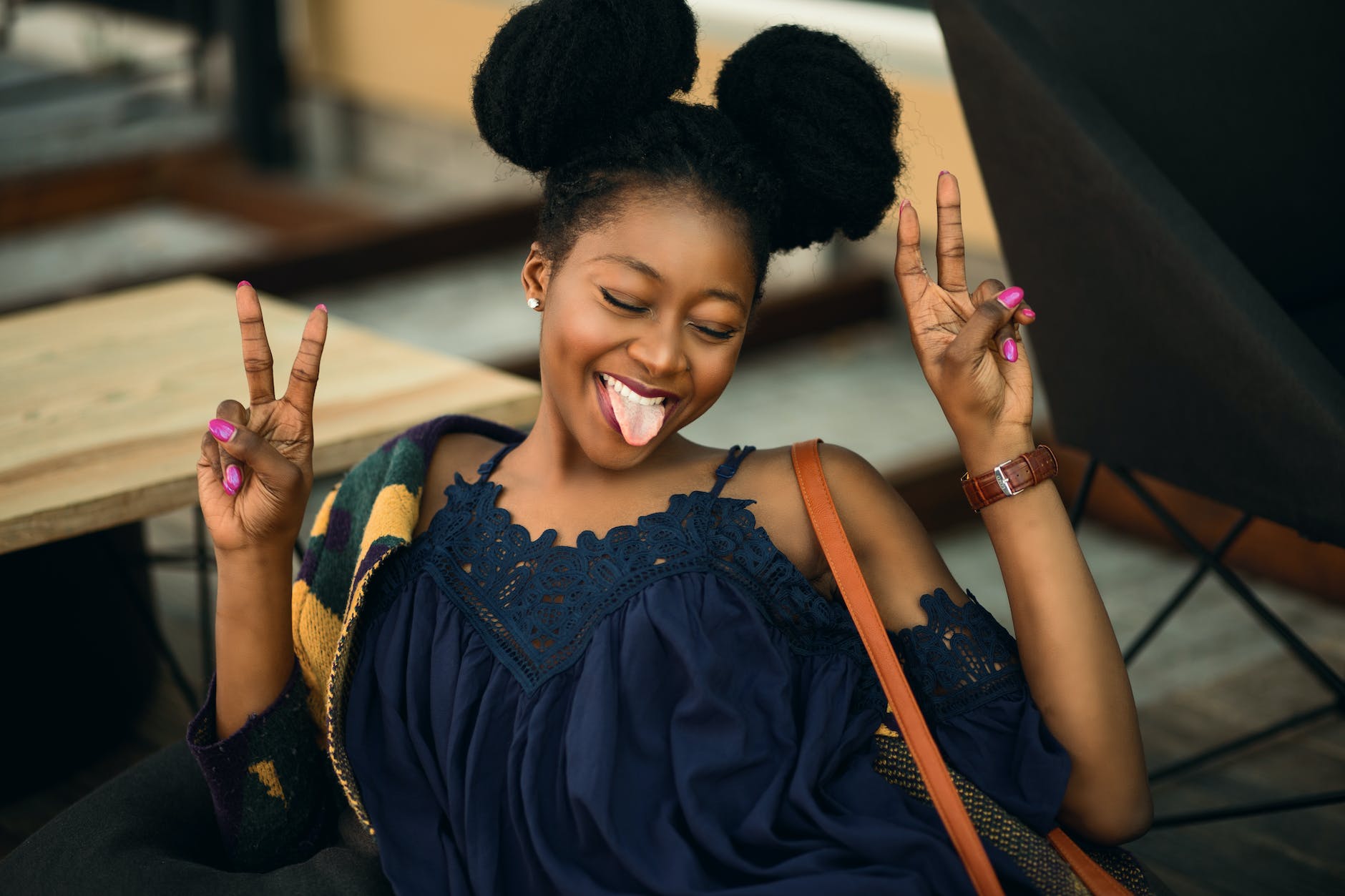
Life without a little fun is stale.

Is fun a human right?

In short. Yes. (Gasp)…yes… the right to fun, although not worded that way, does exist. It is not a stand alone right and comes as a response to issues that public administration may not be able to respond to such as burnout, the rising mental health crisis and stressors for those who may have an unhealthy relationship with hustle culture.

Article 31 of the Convention on the Rights of the Child (CRC): recognizes the right of every child to rest, leisure, play, recreational activities and free and full participation in cultural and artistic life.

Of course with some parental control from parents:

Article 5 of the Convention on the Rights of the Child: recognizes the direction and guidance parents give their children should reflect the evolving capacities of each child. When a child is younger, they will need more protection, as they may be more likely to make choices without considering or understanding the consequences.

And arguably for adults the rights to dignity, freedoms (choice, movement, association…etc) can be said to encompass fun. Every right has its limitations, in Namibia these are found in Article 22 of the constitution.

So we’re clear, fun is a legal right.

Is it the person that makes fun fun?

An article in psychology today talks about what makes a fun person fun using the big 5 personality model. This article essentially concludes this;

Extraversion > Introversion ( Extent of being outgoing and social, expressiveness and energy)

Neuroticism < Emotional Stability (Extent of managing emotions)

Open-mindedness > Closed-mindedness (Tendncy not be open to new ideas)

Conscientiousness > Disorganized (Tendancy to be diligent)

Agreeableness > Disagreeableness (Friendliness and general openness to others)

This model has been criticised for being too narrow in some aspects and very broad in others. The terms are broad and can hold in them different other personality traits that may or may not be desirable; eg an extraverted and cruel person (circa Hitler) or an emotionally unstable but very enthusiatic person (although not real, the one coming to mind is Willy Wonka). It is also narrow in terms of the list itself being very short.

There are several other personality scales that measure individual funness. The Myers Briggs Type Indicator is also used to measure funnessof a person. You can read more about it here. The ENTJ was identified as the most fun in one article. But then again the ENTJ doesn’t necessarily get along with all types.

Conclusion: Fun people are usually extraverted (according to the article I read) but fun in general is subjective

Turning something boring into something fun

Listen to the podcast for Pepe’s story on how pressure to pass school resulted in making reading fun.

Different circumstances can result in the need to find new ways of having fun. This is after all, this article challenges us to explore it as far as possible (responsibly of course). Exploring how different rights, not necessarily associated with public administration, can be used. Click here for a list of activities you can use in your local area to excercise this right.

Black History Month: Triumphant or Tragic in 2023?


Black holidays as I’ve known them have been hecticly traced with tragedy. Unfortunately, all the holidays I have experienced have to do with colonial suffering. This month, at my big age, I found out that a lot of people and institutes in Africa also celebrate Black History Month, something I thought was unique to the experiences of those whose ancestors survived the slave trade, another historic event characterised by Black people suffering. The month came after a long struggle to make sure that Black stories are never lost. I won’t get into the history of it too much, if you’d like a quick history, you can read about it here.

The slave trade and colonial era were undoubtedly an operation of the mass erasing of Black consciousness. A month dedicated to undoing this harm must have been a huge win, considering that the establishment of this this took place between 1970 and 1986 in a more openly and violently racist world. The first celebration kicked of on 2 January till 28 February 1970. Somehow this has moved down to just the 28 days of February and has been clumped up with LGBTQ+ month in the UK.

The decision to have Black History Month in February was in honour of the birth of President Lincoln who is credited for criminalising slavery , and the death of Fredrick Douglass a black former slave and abolitionist.

There is an implication around this that doesn’t sit well with me. Some sense of duplicity I feel when I think that the timing was based on the birth of a white man on a pedestal for admitting that “Black people are people too,” and laying it on the tragic death of a Black man who spent his life fighting to prove this fact and could not enjoy it almost to say ” Celebration for the black people comes throug suffering.” Maybe I’m being too pessimistic in may analysis but something about it highlights the current nature of many African holidays. That they are anchored on the deaths of Black people who died fighting for what they could not experience and exist in the shadow of more lighthearted holidays birthed by white people, like Christmas, Easter Day and April Fool’s Day. Sure we can be a part of the fun, but it is not a fun we designed, it was given to us, and when it’s purely about us, it’s about how much suffering we have apparently overcome.

Maybe I’m just drawing at strings here, but, while I see how Black History Month is worth celebrating, I find it difficult to think of it as less than sad in 2023. If not celebrated, it dismisses efforts put in by Black advocates and activists, if celebrated with full glee then it disregards the fact that this is the bare minimum and that we need to uplift the value of more culturally appreciative holidays. A lot of whitewashing needs to be undone, and many generations have grown with the view that indigenous holidays are ‘evil’, that the bare minimum and assimilation are better than carving out an identity. Let us never forget those who struggled to get us to where we are, and let us move on to honouring who we are. Even if a customary group viewing a holiday is less than a dozen, I still say its better to sing in the joys of the practices that have shaped us, to contribute to the evolution of tradition, rather than to watch customs die and forever sing of the times we suffered like we had no joy.

With that said, happy Black History Month…

On the destructive nature of the term ‘pick me’ in the African Feminist Movement

Photo by Ketut Subiyanto on Pexels.com

*Note that ‘African’ here is used to refer to black people, including those historically displaced by slave trade and the colonial and neo-colonial processes. 

It’s 2021 and the feminist movement has circled right back to the unnecessary out-grouping through the #Pickme and #Tweetlikeapickme trends. I say circled back because it has been pointed out through many historical events have shown to us that more than anything that divisiveness is counter-productive to the feminist movement. It became clear that any racial divisions that were underlying in the women’s suffrage movement resulted in wins that only really benefited the white women who had the significant racial advantages of the time, it did not result in a successes for all women, hence the ensuing waves of feminism and identification of the African Feminist Movement, often with limited trend based participation from those who benefitted from earlier movements.

The African Feminist Movement functions alongside other human rights movements as we saw during the 2020 BLM protests following the cruelty the world witnessed against George Floyd, it was clear that the injustices associated with being black resonated among black people all over the world. Feminist protests in solidarity with this captured Angela Davis’ notion that Black Lives Matter embodies feminism. Anyway, I digress, my point is this movement cannot be a success for as long as there is any amount of injustice existing  alongside it, this is why it does not make sense to me that it be the source of any amount of injustice especially when it is directed towards women, the very group it seeks to protect. Out-grouping seems to only be recognized as an injustice when it captures men as the villains, e.g the exclusion of women from the workforce, but what about when it villainizes the people the movement seeks to protect? In this regard, the out grouping of the pick-me seems totally justified because she has aligned herself with men.

A comparative look at the unjust out-grouping of transgender women and the out-grouping of the pick-me. In both instances there seems to be a failure or refusal to accept that ‘they’ are women too, your need to understand and accept them is not the point , the point is that the movement seeks to defend us in all our differences. No woman needs to fulfill a certain standard to gain validation of her femininity, this includes the pick-me. The exclusionary ‘they’ labeling is what I am addressing here. It is counter-active to the goal of unification and change, an unnecessary divisive pause which strengthens the solidarity of those against the movement.

The pick me phenomenon was created to call out women who were allegedly directing their actions in favour of the male gaze. It came as a response to women who supposedly thought they were better because they fulfilled the terms of the patriarchy. A common example is the classic African church aunty who chastises young women because of how they fail to meet the patriarchal standard of the perfect woman, one who simply accepts the rules that are there to make the life of a man simpler; cook, cleaner, passive sister-wife, child bearer and rearer, modest dressing beautician with a wild side in the bedroom, one who strives for marriage through being a man pleaser… the whole lot.  Or the ever portrayed chill, all vibes girl who has gained the trope of ‘not being like other girls.’ Although the term seeks to make the women reflect and change their behaviour, the interests and characteristics of those who allegedly fit this description often spills over to innocent bystanders. For example, the African church aunty may hold a deep respect for women’s rights while enforcing rules to do tasks and chores around the household as a means to add healthy structure and discipline in a young woman’s life, she may view this as a healthy way to prepare them for an unbalanced world especially if she felt these lessons were helpful to her and her generation mates. The chilled girl and her trope may have been a result of undue male sensationalism rather than a deep desire to seek the male gaze, the interests she is often described to have can be had by anyone, the application of the term ‘pick me’ in association with specific interests alienates any young woman who may have those interests and further distances them from the feminist movement, rejecting what has rejected a part of who they are. It is a term that often neglects context and situations with the sole goal of exclusion.

Granted there are characters who have fed into maintaining patriarchal views, she is no more a threat to the movement as a whole than a child who believes some things are just for boys and some are just for girls. The true villain is the one who taught them that and keeps enforcing it, the real villain is the one who has made those views seem to be facts. More often than not we see that this woman has been taught that there is virtue in resilience and endurance, in many cases she suffers some form of oppression as well. She may choose to accept it as a norm or may really be enjoying the benefits that are beside this suffering, she does not mind her reality. A narrow focus on creating a blanket “type” of woman like this, distracts from the greater reality, which is that of the oppressive force behind her, aiding that position by giving sense of justification to be antagonistic.

While this woman, the pick me, has contributed to the oppression and confinement of other women, oftentimes seen as the face of men’s rights movements that undermine feminism and believe feminism to be an anti-men movement, with little to no knowledge of the intersectional aspect of feminism, her goal may be to protect the men in her life who have been helpful to her, her fight, albeit naïvely informed, is against social exclusion and in favour of some sort of justice. In this regard her actions only manifest as further evidence of the injustices that feminism seeks to fight, she is not an enemy, just a tragic tool of the enemy, like if the movement against black slavery became solely focused on putting down house slaves or those who worked along the slave masters. They were a sore part of the problem, but they were not the problem.

The context in Africa is such that divisions were created through the formation of very static boundaries between countries, various language groups, customary groups, dialects not to mention factors such as colourism and the massive gaps between social classes. There are injustices surrounding each factor I have mentioned, which have caused and still cause separation between people who are suffering together, there is no need to create any more division among ourselves.

It is a term that ultimately defies the entire goal of the movement. If anything the ‘pick me’ should gain some empathy for being trapped or viewed simply as a woman who is living her own truth, even if that truth is not particularly palatable, she must be addressed, individually on her view points directly, rather than to create an exclusionary term, fulfilling the movement’s desire for non-gender specific classifications. To give this group of women a diminutive term only creates more division in a group that would probably be more successful if there were efforts to create solidarity, an unnecessary division at that which only amplifies the perspectives of those against it; the idea that feminists claim to be in favour of amplifying all women’s rights in all their phenomenal uniqueness, yet still excluding women who act in a certain way.

So what if she claims to be better and gains the attention of a man? Or iff she is a ‘puppet for the patriarchal agenda?’ It is inconsequential if the women who are part of the feminist movement are pushing that agenda rather than placing efforts on petty out-grouping, it is the equivalent of echoing their alleged message that ‘you are not a good enough woman!’