ǂAONI //AES : Reclaiming the Historic Narrative of the ǂAoni People Through Theatre

Section 6 of the Swakopmund Protocole

The owners of the rights shall be the holders of traditional knowledge, namely the local and traditional communities, and recognized individuals within such communities, who create, preserve and transmit knowledge in a traditional and intergenerational context in accordance with the provisions of section 4.

The application of this section is partially significant for how it allows customary groups to take ownership of their stories. The colonial era had oppressors taking the role of the authority on people’s stories. While we remain grateful for education, we can’t neglect the messaging that, “foreign knowledge is superior to indigenous knowledge.” This has played out as indigenous people not often being at the forefront of being historians of their own cultures. Since independence, many cultural groups have been making efforts to correct the stories that have been told about them. In this article we’re covering two works that have been conducted in Namibia, surrounding the cultural relationship between people and the ocean.

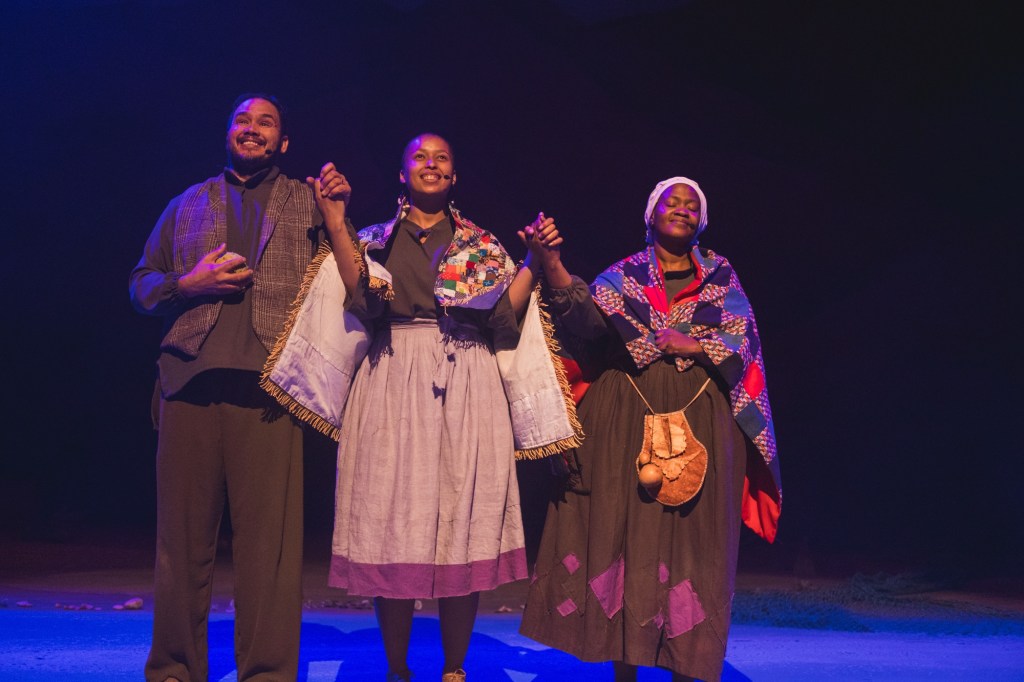
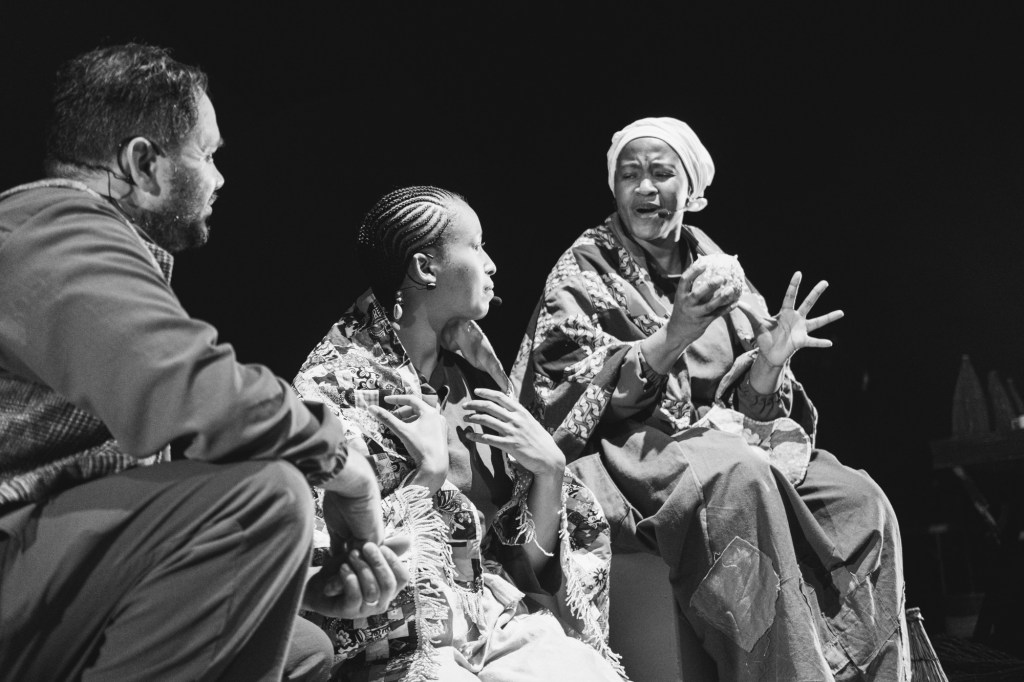
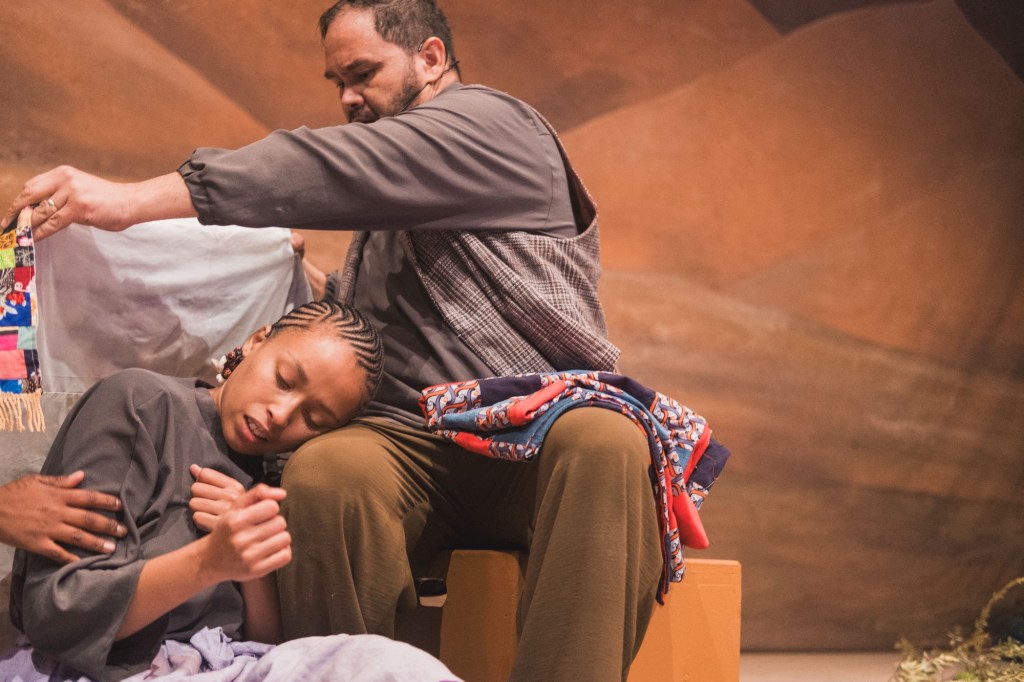
A phenomenal production retelling the story of the ǂAoni people and the ocean. The play consists of a cast of three, the father (Dawie Engelbrecht), the mother played by Hazel Hinda and their daughter Khoendikhoes, played by Chantell Uiras (Diolini). The story follows the three as they revisit the events of the colonial past and how these impacted on the current socioeconomic position of the ǂAoni people, a clan of Nama people mostly found around the !Kuiseb river in the Erongo region also referred to as the Topnaar community.
Setting things straight

One of the main issues covered in this play is that of the history of the community. Colonial era historians alleged that the community’s displacement during the colonial era was in response to countering fighting within the community and harm to the natural environment. The story starts by letting us know who these people were recognized as, ‘the water people’ or guardians of the water and marine life. Their role as caretakers was undermined by the ambitions of the colonizers. It was also clear that they were moved without consultation and that it was carried out in a forceful and chaotic manner. They did not stand a chance against the armed invaders and had no other choice but to comply. An all too familiar history. Before anyone else felt the hit of the colonial invaders, they, being at the coast, felt the first and strongest blows, and because the settling of foreign invaders on the coastal territory did not help their case much.

They spoke of the !Nara fruit (Acanthosicyos horrida), how it was not just food, but the unique way in which each family farmed it was a way to distinguish between families. After the displacement, restoring the practices that were central to their cultural identities has been a struggle not so much because they have lost the capacity to do so, but more because of the policies put in place to make sure that they never do Policies that have seen their way into post-independence Namibia. The play was not made out to be an attack on the contemporary government, but a channel to shed light to the fact that they (the Topnaar community) too are a people that were uniquely disempowered by the apartheid system, and that their story continues to be swept under other emerging and apparent issues. The story has been written in collaboration with academic research institutes like the University of Namibia (UNAM), One Ocean Hub, Global Research Fund, and UK Research and Innovation. Researchers such as Robert Vigne are also amongst those who have showcased the significantly disproportionate level of harm faced by the Topnaar Community during the colonial era. It’s safe to say that the message shared is one grounded in facts not a baseless critique.

When speaking to the audience after the play, a leader from the ǂAonin community, Joel Kooitjie, as well as, acting chief of community Stoffel Anamab, pointed out the struggles that their people continue to face today. Some impacts include the fact that they are only about two Topnaar people in local authority offices and that decision makers in their area can sometimes fail to capture their context very well and ultimately miss their needs. Furthermore, as a community that had largely survived on marine life for sustenance, bearing witness to the harm the ocean and its creatures have faced while disempowered from taking any feasible steps to help serves as a testament to the gradual weakening of their own development, this is in part because a great amount of their income came from inland circulation of oceanic goods. The historical and cultural relevance of ocean governance in this community has been significantly undermined and resulted in having to re-adapt to a life where their strongest skills remain in the backburner. It goes without saying that this need to suppress who they are in order to be convenient for invaders is a level of robbery that digs at the core of personhood.
Conclusion

The play ǂAONI //AES is an example of the Swakopmund Protocole at work. It’s the active reclaiming of a history by the people. It is also an assertion of who they are and who this land has known them to be. The impoverishment and struggle they face today is a result of being subject to a system that has unfortunately kept them down. The post-colonial government canntot take the blame for this, but, in their continuous efforts to decolonize Namibia, they can take the Topnaar Community and their pleas into consideration. 
Black History Month: Triumphant or Tragic in 2023?


Black holidays as I’ve known them have been hecticly traced with tragedy. Unfortunately, all the holidays I have experienced have to do with colonial suffering. This month, at my big age, I found out that a lot of people and institutes in Africa also celebrate Black History Month, something I thought was unique to the experiences of those whose ancestors survived the slave trade, another historic event characterised by Black people suffering. The month came after a long struggle to make sure that Black stories are never lost. I won’t get into the history of it too much, if you’d like a quick history, you can read about it here.

The slave trade and colonial era were undoubtedly an operation of the mass erasing of Black consciousness. A month dedicated to undoing this harm must have been a huge win, considering that the establishment of this this took place between 1970 and 1986 in a more openly and violently racist world. The first celebration kicked of on 2 January till 28 February 1970. Somehow this has moved down to just the 28 days of February and has been clumped up with LGBTQ+ month in the UK.

The decision to have Black History Month in February was in honour of the birth of President Lincoln who is credited for criminalising slavery , and the death of Fredrick Douglass a black former slave and abolitionist.

There is an implication around this that doesn’t sit well with me. Some sense of duplicity I feel when I think that the timing was based on the birth of a white man on a pedestal for admitting that “Black people are people too,” and laying it on the tragic death of a Black man who spent his life fighting to prove this fact and could not enjoy it almost to say ” Celebration for the black people comes throug suffering.” Maybe I’m being too pessimistic in may analysis but something about it highlights the current nature of many African holidays. That they are anchored on the deaths of Black people who died fighting for what they could not experience and exist in the shadow of more lighthearted holidays birthed by white people, like Christmas, Easter Day and April Fool’s Day. Sure we can be a part of the fun, but it is not a fun we designed, it was given to us, and when it’s purely about us, it’s about how much suffering we have apparently overcome.

Maybe I’m just drawing at strings here, but, while I see how Black History Month is worth celebrating, I find it difficult to think of it as less than sad in 2023. If not celebrated, it dismisses efforts put in by Black advocates and activists, if celebrated with full glee then it disregards the fact that this is the bare minimum and that we need to uplift the value of more culturally appreciative holidays. A lot of whitewashing needs to be undone, and many generations have grown with the view that indigenous holidays are ‘evil’, that the bare minimum and assimilation are better than carving out an identity. Let us never forget those who struggled to get us to where we are, and let us move on to honouring who we are. Even if a customary group viewing a holiday is less than a dozen, I still say its better to sing in the joys of the practices that have shaped us, to contribute to the evolution of tradition, rather than to watch customs die and forever sing of the times we suffered like we had no joy.

With that said, happy Black History Month…

African Sovereignty: Oligarchs and Paradoxes

Photo by Blue Ox Studio on Pexels.com

A paradox occurs when an element despite sounding or seeming true and logical also presents a logically acceptable feature or element which creates a contradiction and oligarchs are instances where only a small number of people have control over a country. Here I discuss the independence of post colonial systems. The true sovereignty of the nations is questionable, there is an expectation of freedom due to being rid of colonial rulers, yet an overwhelming sense of being trapped by the same systems they were allegedly liberated from. Here we assess the authenticity of that liberation.

Education

“The percentage of Africans living in absolute poverty fell from 58 to 41 percent between 2000 and 2016 and primary school enrolment had increased from 60 to 80 percent, most of the poorest economic performers in the UN’s human development index remained African countries.”

Education is supposed to be liberating, and oftentimes, used in the right way it can be. African countries have increased the rate at which their people are educated since the colonial era, yet still, continuing to feature on the index of the most poor countries and continue to face such heightened levels of corruption and debt. Quoting here from Adekeye Adebajo’s Pan-African Pantheon;

“It is unfortunate that we should be so educated, so liberated with regards to knowledge yet continue to be counted among the most suffering and even be placed bottom on a tier of world. Understandable considering that this system seeks to undo the impact of hundreds of years worth of damage. What is paradoxical is the use of educational systems and standards of those who caused that damage. Globalization has made the use of these a necessity particularly if one seeks to engage with the rest of the world, however globalization has effectively made the nature of educational sovereignty slightly more complex.”

Western education has remained consistently present since the colonial era with subtle changes to suit the African context. However it’s effect and ability to create a sense of superiority of the West remains.

Globalization may be praised for allowing people to reject the notion that the founding parties are doing their best when they can see that there is potential for improvement. The other side of this coin is that the difference in progress coupled with the consideration of the impacts of colonialism often create despair and results in a people despising their ‘underdevelopment’ rather than see opportunity in it, essentially one may learn that that true liberation exists by existing the in the way those in the first wold live.

One of the limitations counted that contribute to this may be the conditioning to revere the colonizers that comes with self-hate, and despite how it has been explored through movements such as Black Lives Matter and the #blackisbeautiful, in the face of skin lightening products and instances of colourism, it is still clear that the application and internalisation of these lessons is very gradual.

Another is the openly corrupt and overly bureaucratic systems that have been created in many African countries. Many of these systems have done very little to dispel the appeal of foreign-hood, especially if it can be an avenue to develop one’s home along with the home of that which accommodates them. One cannot be called home when the crocodiles that ravaged them before are still out, still menacing home. A lot of blame for this falls on leaders who have brutalized their countries so much that one cannot function within it or develop it without facing immense difficulties.

When one is taught of the great and wonderful things out there and shown how impossible it is to implement them at home, it creates a hunger for the life out there and an individual rather than societal pursuit of happiness.

Why not point out these failings in an educational rather than solely through social setting? Because it has been made difficult by the leaders who seek to maintain positions of power rather than improve their countries. All while making it impossible to hold them accountable without risking one’s life. Herein lies neo-colonialism and how the leaders who represent the people seek to benefit from it, much like African leaders of the colonial era who sold their people. The ZANU PF régime in Zimbabwe for example famously watered down the actual harm and issues in fear of being held accountable to their actions. In many African countries like this , where the founding parties impose themselves so much that change is inconcevable individuals often truly realize the harm of their leaders long after they have been conditioned to accept or function under the status quo.

Democracy

Democracy was meant to be a liberating tool following the colonial era, however it has become a means in which founding parties can maintain their paternalistic hold on their nations. It seems like they worry so much that any other party would shift the systems to suit their own desires the way they have been since the dawn of independence or an act fulfilling the aforementioned fear of being held accountable.

On the backdrop of colonially solidified elements such as tribalism, regionalism and colourism, democracy here functions in the manner it did for them during the apartheid era. Such that power is unequivocally in favour of the one who produced greater numbers.

Three elements which seemingly appear separate are consistently at play here. These are the social moral narrative, the traditional group with territorial dominance and the colonial history and liberation struggle. These often overlap in the sphere of politics and have often manifested as an emphasis on the colonial history and liberation struggle to justify the power hold of the founding party which often includes the ethnic majority wherein they ultimately drive their own social moral narrative. Essentially what is meant to be a democratic system, functions as an oligarchy that only benefits a few.

These factors when placed near the ever propagated value of community in deciding a leader, can make a lot of people make decisions based on community biases rather than on the political discourse. This cannot really help democracy to function fairly, especially because there are several cultural groups, each with varying population distributions, the vote of the majority usually ends up being a tool for the most dominant group to remain in power. Essentially the experience of sovereignty is something that can truly be experienced by those with oligarchal control over the states.

Gender Based Violence

 The University of Namibia much like many other African Universities has an increased number female graduates yet the uproar regarding gender based discrimination to young women is still prevalent in the country and was notably marked by the #Shutitalldown protests that occurred in 2020. Additionally, despite globalization and significant judicial activism in cases such as Chairperson of the immigration Selection Board v Frank and Another the country still operates what the World Bank has dubbed “the silent epidemic,” wherein gender based violence has greatly been directed towards members of the LGBTQ community, unfortunately rather than emphasize the need for greater attention in this area, there is often an attitude pf passive acceptance because it hapens so often it is simply taken to be normal. Cultural biases of heterosexual male dominance feed into this immensely and often result in the prevalence of such crimes.

A 2020 UN report titled “THE TIME IS NOW: ADDRESSING THE GENDER DIMENSIONS OF CORRUPTION,” it was revealed that corruption is mostly practised by men because they are less scrutinized for it. The same research revealed that women are less likely to get poitions of power because there is an overwhelming bias that women are corruptable. This is not a plea to let women comfortably be corrupt but merely highlighting how this exclusion has also limited the inclusion of women’s issues beyond a manner of passive political discourse. When those who are affected are not always part of the conversation it makes it difficult to prioritize their issues.

Oligrachal powers are yet again seen at the forefront of this seen in many African countries primarily prioritizing their own perspectives and as reflected in the consistant insances oof harm against women. Amnesty International found in its briefing,“Treated like furniture: Gender-based violence and COVID-19 response in Southern Africa”, that “women and girls who dare to report violence and abuse risk social rejection for failing to conform to gender roles — and when they do speak out, their complaints are not taken seriously by authorities.”

Production and Consumerism

While the sovereign African countries have had a great increase in the number of people who can make purchases such as homes, cars, even little delights like corn flakes cereal, no longer restricted by racial lines of who can own these things. Yet still while there has been liberation under the guise of glorious consumerism, this comes at the cost of development as Adebajo points out;

“African economies were thus structured – as the economies in the Caribbean and the Americas had been for two centuries- to produce crops to meet the European consumer needs. This both increased the dependence of African economies on metropolitan economies and in many cases, negatively impacted on the ability of African populations to produce their own food. Africans imbibed Western consumption patterns without acquiring Western production methods.”

While we were empowered as consumers, we were not yet sufficiently empowered as producers, the channels to such have been left to the hands of the western powers, in addition is America which has successfully incorporated Africa in its consumerist culture and China which has played a huge role in heading Neo-colonialism. These tools have left Africa unfortunately in debt and still at the mercy of other powers economically while still functioning as providers of the necessary materials for production; cocoa beans, gold, diamonds, etc…. In this way the goal of colonization to reduce Africa into a source of economic gain and sustenance for foreign powers continues to play out even after the poat-conflict idea that Africa was now free and independent.

At the forefront of this is the role of the oligarchs in Africa. In a report by the African Investigative Publishing Collective, it was stated that, “African oligarchs do a lot more than accepting bribes…what we have unearthed indicated that these elites have, to some extent morphed into the very colonialist plunder systems that they replaced.”

Conclusion

Obtaining true sovereignty in Africa is undoubtably a slow process due to the deeply embedded manner in which colonization occured. An important battle to face in this process is being rid of leaders who synonimize democracy and oligarchy as well as systems that make advancement more difficult that it has to be.