

Age Rating: 16+
*There’s a couple of spoilers in here*
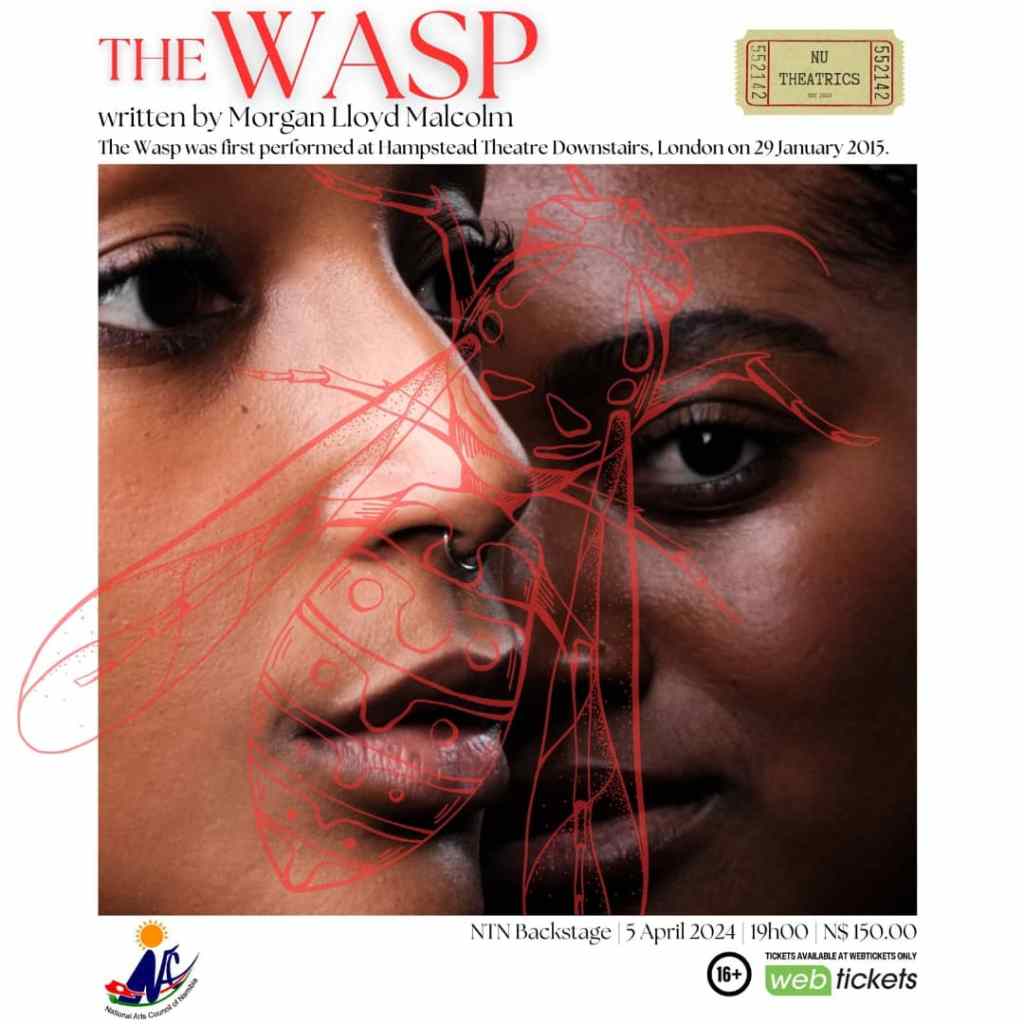
NTN (The National Theatre of Namibia) came back with a bang and I am more than glad that I didn’t skip this play, The Wasp was, in one word, jaw-dropping. When we act like there’s no elephant in the room, it will eventually stomp us. That’s one of the major themes in NTN’s latest production “The Wasp.” This play is not for the feint-hearted, you might just question your own ethics while watching it, at least that’s what I found myself doing during the climax of this, thriller.
The Wasp is the story of two women, who reconnect after years to rekindle what they keep referring to as a friendship, but, friendship is the furthest term I’d use to describe this relationship. They are the only two characters we meet and they’re all we need, Morgan Lloyd Malcom’s writing this had a fly on the wall effect to it, giving us the sense that we know the characters very well through us eavesdropping on some very hush hush conversations, meanwhile still being able to deliver twists that keep the audience hooked. So a 10/10 from me on those stage directions and the dialogue. Here are my biggest takeaways from this play:
On Friendships and “Friendships”
Ever wondered what the worst case scenario could be in a friendship where unaddressed competition and bitterness are at the core? Well The Wasp does a great job at showing us just what might happen if you and that frienemy keep walking on blurred lines. This play shows us that things can change and eventually something has to give in blurred line based relationships.
The play starts with a meeting at a café between the two, Heather and Carla. Heather has become wealthy since their school days while Carla lives more paycheck to paycheck, the remnants of what was a love-hate relationship between the two are clear in how they speak to eachother. In in their first meeting in years, the awkwardness of an unlikely meeting between two people who had fallen out was very well portrayed and spilt over into the audience. It was clear that there were a lot of unspoken words between them throughout that first meeting. Carla has little patience for any outside opinions about her, she has shown up fully prepared to fight Heather, should the need arise, it doesn’t, but if it had, best believe Carla was ready to go from the very beginning. Meanwhile, Heather is the embodiment of the seemingly polite aristocrat whose back handed statements are delivered like they are either facts or gifts.
Heather has a proposition, for Carla to kill her husband. Why Carla? A strong belief in her capacity to be callous. The oddness of the proposition struck us all, a very much needed “o O” from one of the audience members, vocalized what we were all thinking. If someone wants their husband, or anyone killed, why would they reach out to an old high school frienemy? Well the twist ending was the perfect pay-off for this confusion.
All too often fears of being alone, the need to assimilate or be one of the ‘cool kids’ can lead to whitewashing rather than confronting violations. This play shows how, if left unaddressed, these dynamics can spill over well into adulthood. How talks of ‘healing the wounded inner child’ don’t just stop at some internal reflection, but also involve looking at addressing conflict and hurts from other people, and how if that doesn’t happen, the cycles continue until either you or the cycle are broken.
The Authority of the Sacred Victim
*Big spoilers here*
Molly Brigid McGrath published a paper called “The Authority of the Sacred Victim” in 2020 which talks about the harms of maintaining a template of how a victim should be observed. That the possibility of harm by a social victim can result in the creation of new villains. It is wrong when an individual uses their trauma to justify causing trauma, it explains it, but it definitely doesn’t make it right or acceptable. This play does an excellent job at exploring that. It takes this a step further by giving us two protagonists who have understandable backstories for why they are the way they are, and why they do the things they do. Heather is the one looking to murder her husband for infidelity, resorting to catfishing Carla and spying on her before presenting this proposition, and even convincingly threatening to torture and kill Carla after the proposition is made. On the other hand, Carla violently bullied and sexually assaulted Heather in high school, because she was the more teacher’s pet type and her family was more loving than Carla’s abusive family. I’ll admit that it’s easier for me to lean towards Heather in this situation, bullies, especially the ones who do it intentionally not out of ignorance, are disgusting. Yup, I said it and I’d say it again. But the play is written in a way that asks us to both empathize with and dislike these two. Both are ‘sacred victims’ and the finale has one offering the other a way out, to choose to walk away and be forgiving, and start a new chapter or to embrace animosity. The choice she made was definitely worth the wait (not spoiling everything ).
Perfect is in the eye of the beholder
We are introduced to Carla the pregnant Mother of five sitting outside a café and smoking and Heather enters the scene making her out-of-placeness apparent. This place is a casual enough place for Carla yet too casual for the likes of Heather. On first listening their ‘have and have not’ relationship makes Heather’s situation more preferable until she speaks about how much she’s been struggling to have children. Carla dangles her upper hand in this instance and even offers to become a surrogate for some money, bragging about how easily she can get pregnant. After some awkwardness over this, the two gossip a little about a former classmate who is in a relationship with a serial cheater, briefly sharing a high horse over this before even that high horse is broken by how differently they think about it. Carla thinks its normal for men to cheat, the role of the woman is to tighten the leash on him, while Heather believes men should not be excused for such behavior. (Very much noted the heteronormativity of these views and their normalcy.)
Each woman is desperate to escape aspects of their lives. Heather longing for a healthy family of her own while Carla hopes for financial freedom. In our discovery of this, each one is free and confident with whatever they have over the other, and to point out the inferiority of the other. It is Heather who announces Carla’s difficult financial situation, repeating how desperate she must be, and that she’d “obviously” do anything for money. And while Heather speaks of her marital and fertility struggles, it is Carla who emphasizes how easy this part of life should be and adds salt to the wound by making light of Heather’s struggle, the discovery of the abuse in high school make Carla’s jokes more jarring and almost make her seem inhumanely cruel.
Conclusion
All in all, this play is fully worth the watch. If the opportunity ever presents itself, GO WATCH IT!!! These are only a few of the themes I picked up but there’s a lot more I left out. The cast, stage design, directions, all of it were a superb “welcome back to the theatre.” I hope to see more from this writer and can’t wait to see what else NTN has in store for us.

 ZENZE
ZENZE 