
The Wasp (A Review)

Age Rating: 16+

*There’s a couple of spoilers in here*
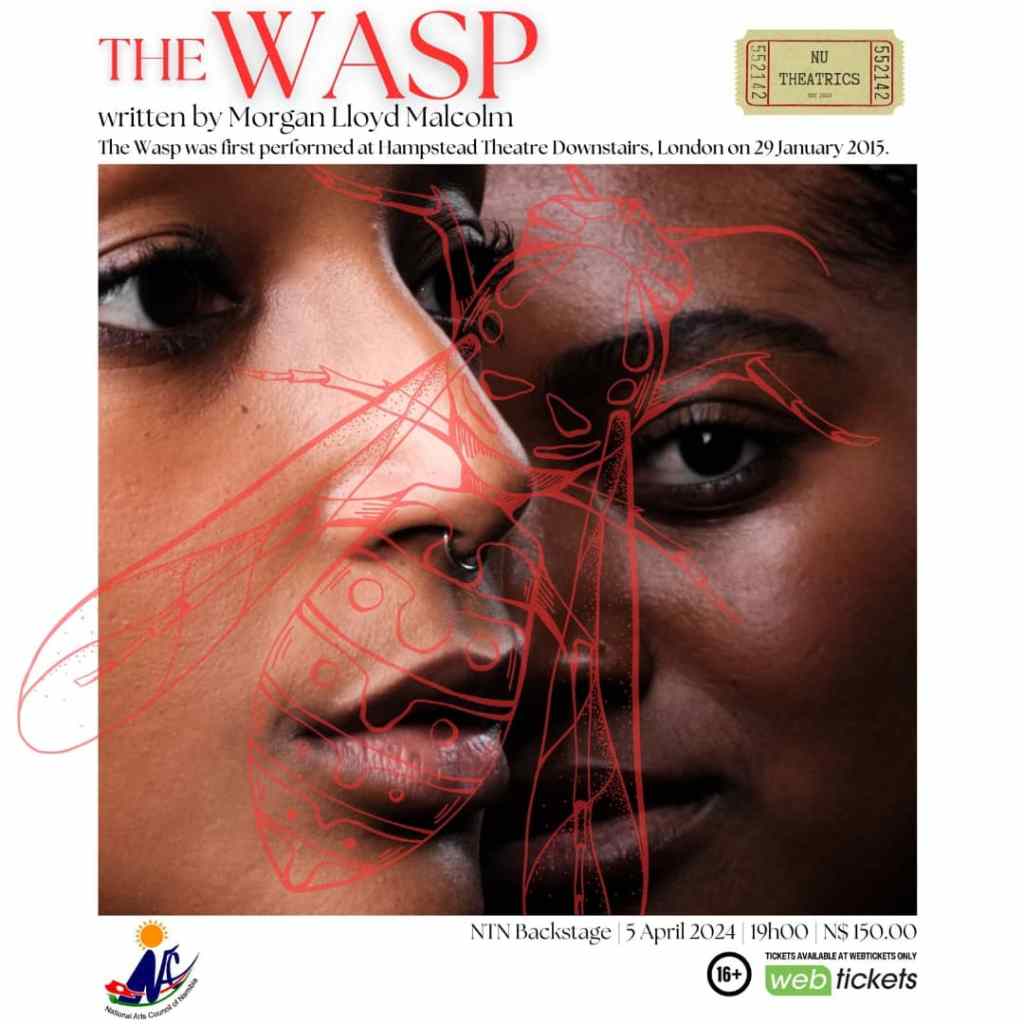
NTN (The National Theatre of Namibia) came back with a bang and I am more than glad that I didn’t skip this play, The Wasp was, in one word, jaw-dropping. When we act like there’s no elephant in the room, it will eventually stomp us. That’s one of the major themes in NTN’s latest production “The Wasp.” This play is not for the feint-hearted, you might just question your own ethics while watching it, at least that’s what I found myself doing during the climax of this, thriller.

The Wasp is the story of two women, who reconnect after years to rekindle what they keep referring to as a friendship, but, friendship is the furthest term I’d use to describe this relationship. They are the only two characters we meet and they’re all we need, Morgan Lloyd Malcom’s writing this had a fly on the wall effect to it, giving us the sense that we know the characters very well through us eavesdropping on some very hush hush conversations, meanwhile still being able to deliver twists that keep the audience hooked. So a 10/10 from me on those stage directions and the dialogue. Here are my biggest takeaways from this play:

On Friendships and “Friendships”

Ever wondered what the worst case scenario could be in a friendship where unaddressed competition and bitterness are at the core? Well The Wasp does a great job at showing us just what might happen if you and that frienemy keep walking on blurred lines. This play shows us that things can change and eventually something has to give in blurred line based relationships.

The play starts with a meeting at a café between the two, Heather and Carla. Heather has become wealthy since their school days while Carla lives more paycheck to paycheck, the remnants of what was a love-hate relationship between the two are clear in how they speak to eachother.  In in their first meeting in years, the awkwardness of an unlikely meeting between two people who had fallen out was very well portrayed and spilt over into the audience. It was clear that there were a lot of unspoken words between them throughout that first meeting. Carla has little patience for any outside opinions about her, she has shown up fully prepared to fight Heather, should the need arise, it doesn’t, but if it had, best believe Carla was ready to go from the very beginning. Meanwhile, Heather is the embodiment of the seemingly polite aristocrat whose back handed statements are delivered like they are either facts or gifts.

Heather has a proposition, for Carla to kill her husband. Why Carla? A strong belief in her capacity to be callous. The oddness of the proposition struck us all, a very much needed “o O” from one of the audience members, vocalized what we were all thinking. If someone wants their husband, or anyone killed, why would they reach out to an old high school frienemy? Well the twist ending was the perfect pay-off for this confusion.

All too often fears of being alone, the need to assimilate or be one of the ‘cool kids’ can lead to whitewashing rather than confronting violations. This play shows how, if left unaddressed, these dynamics can spill over well into adulthood. How talks of  ‘healing the wounded inner child’ don’t just stop at some internal reflection, but also involve looking at addressing conflict and hurts from other people, and how if that doesn’t happen, the cycles continue until either you or the cycle are broken.

The Authority of the Sacred Victim

*Big spoilers here*

Molly Brigid McGrath published a paper called “The Authority of the Sacred Victim” in 2020 which talks about the harms of maintaining a template of how a victim should be observed. That the possibility of harm by a social victim can result in the creation of new villains. It is wrong when an individual uses their trauma to justify causing trauma, it explains it, but it definitely doesn’t make it right or acceptable. This play does an excellent job at exploring that. It takes this a step further by giving us two protagonists who have understandable backstories for why they are the way they are, and why they do the things they do. Heather is the one looking to murder her husband for infidelity, resorting to catfishing Carla and spying on her before presenting this proposition, and even convincingly threatening to torture and kill Carla after the proposition is made. On the other hand, Carla violently bullied and sexually assaulted Heather in high school, because she was the more teacher’s pet type and her family was more loving than Carla’s abusive family. I’ll admit that it’s easier for me to lean towards Heather in this situation, bullies, especially the ones who do it intentionally not out of ignorance, are disgusting. Yup, I said it and I’d say it again. But the play is written in a way that asks us to both empathize with and dislike these two. Both are ‘sacred victims’ and the finale has one offering the other a way out, to choose to walk away and be forgiving, and start a new chapter or to embrace animosity. The choice she made was definitely worth the wait (not spoiling everything ).

Perfect is in the eye of the beholder

We are introduced to Carla the pregnant Mother of five sitting outside a café and smoking and Heather enters the scene making her out-of-placeness apparent. This place is a casual enough place for Carla yet too casual for the likes of Heather. On first listening their ‘have and have not’ relationship makes Heather’s situation more preferable until she speaks about how much she’s been struggling to have children. Carla dangles her upper hand in this instance and even offers to become a surrogate for some money, bragging about how easily she can get pregnant. After some awkwardness over this, the two gossip a little about a former classmate who is in a relationship with a serial cheater, briefly sharing a high horse over this before even that high horse is broken by how differently they think about it. Carla thinks its normal for men to cheat, the role of the woman is to tighten the leash on him, while Heather believes men should not be excused for such behavior. (Very much noted the heteronormativity of these views and their normalcy.)

Each woman is desperate to escape aspects of their lives. Heather longing for a healthy family of her own while Carla hopes for financial freedom. In our discovery of this, each one is free and confident with whatever they have over the other, and to point out the inferiority of the other. It is Heather who announces Carla’s difficult financial situation, repeating how desperate she must be, and that she’d “obviously” do anything for money. And while Heather speaks of her marital and fertility struggles, it is Carla who emphasizes how easy this part of life should be and adds salt to the wound by making light of Heather’s struggle, the discovery of the abuse in high school make Carla’s jokes more jarring and almost make her seem inhumanely cruel.

Conclusion

All in all, this play is fully worth the watch. If the opportunity ever presents itself, GO WATCH IT!!! These are only a few of the themes I picked up but there’s a lot more I left out. The cast, stage design, directions, all of it were a superb “welcome back to the theatre.”  I hope to see more from this writer and can’t wait to see what else NTN has in store for us.

March Stories : Girls Night Out

Happy April first, we’ve got a new addition to our mini-March stories series, where we’re sharing stories written that center the holidays that we celebrated in the month of March, International Women’s Day, Independance Day and Easter. Girls Night Out is a story that acknowledges violence against women and girls following independence, how it has become something that spoils freedoms hoped for by many freedom fighters and how these terrifying situations have often become just common cautionary tales.

The dance started promptly at 6pm. Thandeka and Mary and I were already there by 5:30 , we didn’t know that people never came early for these events and we’d soon find out that we didn’t need to save up for new high heels unfamiliar make-up and heavy jewelry, we could have easily pulled off a look with some high tops, tube-tops and flared mini-skirts or shorts and lipstick. But it didn’t matter, we had just made it to our first school dance and that’s what mattered the most.

It was well orchestrated, we had told our parents that we would have a hockey match, an away game, and that’d work for a good cover to see the dance through to the end.  None of us was particularly good at hockey, we’d made the team thanks to a quota formality and would tag along and bench. There was no game this weekend though, but we needed an excuse to make this happen, it was the last year of high school and we were going to make it count. The night would end with a sleepover at the home of Thandeka’s aunt, Ms Marange.

She was one of the teachers at the school with a house on campus, and, had played the role of a fairly open-minded older sister to her rather than that of an older mother as her familial title “mainini, young mother” had demanded. She’d go along with their plan as long as they promised to report to her every 15 minutes and to make sure they would head home and do their homework as soon as the dance was over. She was in her late forties, a former soldier who met her husband when he was in exile and moved to his home town soon after the war. He’d remained in the army, and travelled on missions with the NDF and she left that life and was now a drama teacher and writer, known for being unreserved and amicable enough for students to be very liberal in her presence yet firm enough to innerve cold-feet in anyone who thought of disrespecting her.  “Yho, maborn-free with your pre-occupations” she mused upon seeing our shoes. I felt a slight wash of embarrassment because I really felt like an adult in my peep-toed heels.

People started piling into the school hall by 6:30, this was the big Independence day bash that took place annually and was always the source of the juiciest gossip and stories that would illicit a fear of missing out that served as enough justification for lying to our parents. “We were doing this for a greater cause…we must enjoy our youth,” we agreed. By the time everyone was settling in, we were barefoot, dancing in the glory of a very well executed con on our parents and a coming of age moment being experienced. Our fifteen minute report-backs to Ms Marange started off as a group endeavor and after around 8pm became individual check-ins. We’d separated after Terrance, a classmate of ours, had asked Thandeka to dance, Mary and I didn’t want to hover around them, so we moved away and soon enough Mary was swept away by Ndapewa, a girl she’d been enthralled with in the previous year while I remained absorbed in the music and dancing. Ms Marange didn’t seem to mind us splitting up, her responses to our check-ins were a slight nod and waving away while talked to some of the other teachers.

I was just about to show off my routine to Soulja-Boy’s Crank That when Mary tugged at my arm asking where Thandeka was. My impulsive shrug-off was met with a loud, “Where did she go!” from a raging Ms Marange. I knew the fifteen minute mark had just passed but this was a rare opportunity to show off that I knew all the moves from the music video. “I told you girls to make sure you report back every fifteen minutes. Both of you, go and find Thandeka now!” We raced out of the room, averting our eyes from the gaze of our nosey peers, none of whom had a word to say about Thandeka’s whereabouts.

“You were on the dance floor, didn’t you see where she went?” Mary asked.

“Honestly Mary, I wasn’t paying attention. Where’s Ndapewa, why isn’t she helping us look?” I responded in a tone that made my irritability very apparent.

“She’s checking the bathrooms, Marange started with me before we got to you, Ndapewa  and a couple of other students were told to go check the bathrooms and the junior classes, you and I should probably head over to the car-park, the sports field and senior block.” Mary remained unbothered

“Why is she so furious, it’s not like Thandeka has been missing for hours, it’s just been a few minutes.  Did you tell her she was with a boy?”

“No, and let’s keep it that way, you just know she would never let us forget if we did.”

“I don’t know, all I know is that I would rather search for Thandeka for the rest of the night than have my mother know where I really am.” Mary said, making me focus on the bigger picture.

We called for Thandeka and Terrence, scanning through the car park and the sports fields. The more we looked, the more the thought that they were somewhere fooling around eroded. She and Terrance flirted often and passed each other notes from time to time. She once said they had been texting on Mxit throughout the holiday before her phone was confiscated. So we had no reason to suspect that anything was awry. Our walk up to the classes was silent. Neither one of us wanted to discuss the possibility of anything terrible happening to Thandeka. The distress Ms Marange had shown had caught up to us, but neither of us would acknowledge it, jokes about horrid possibilities and expressions of annoyance turned into fast paced marches and echoed calls.

So when we headed back up-school to a crowd in front of the science lab, I was certain that the anvil I felt weighing on my chest had also struck Mary. She was braver than I was though, she shoved through the crowd to find a bleeding Thandeka centering this crowd of mumbling students being herded back by teachers. A teary eyed Ms Marange pacing rapidly on the phone, coupled with involuntary eaves dropping confirmed a worst case scenario that had just been too convoluted for us to plan for. Thandeka wasn’t moving, and Terrance had been taken to a separate classroom. My mind couldn’t comprehend it. Suddenly what had been my worst fear earlier that night paled in comparison to the actual reality. My parents were called, and they too were caught in the surrealness of what had taken place.

A combination of piecing together questions from the police interrogations and newspaper articles eventually helped us draw pictures of what had happened.

Thandeka and Terrence had been dancing, a supervisor who had been reminding them to stay at an arm’s length distance apart, claimed they stopped keeping track of them after realizing that they had been reporting to Ms Marange, and that they generally had been trusted students, so “…they didn’t require as much monitoring as more rowdy students.” A line in a newspaper article read. Eventually they left the hall and snuck into one of the science labs. They began to make-out and eventually she worried about her aunt looking for her, she wanted to head back to check-in, but Terrance insisted that she stay longer, he claimed that they tussled and she fell and hit her head on the corner of the table. Mary and I think he wanted a lot more, she’d wanted to save herself for marriage, and was deathly paranoid about becoming a mother before she was ready. But we only had his version of events.

We didn’t get to talk to Ms Marange after that night, not even at the funeral. To apologize for being lackadaisical about her panic that night. To apologize for putting her in that position and for causing this, to be part of her legacy at the school.

Copyright Zenze 2024

Photo by Hashtag Melvin