ǂAONI //AES : Reclaiming the Historic Narrative of the ǂAoni People Through Theatre

Section 6 of the Swakopmund Protocole

The owners of the rights shall be the holders of traditional knowledge, namely the local and traditional communities, and recognized individuals within such communities, who create, preserve and transmit knowledge in a traditional and intergenerational context in accordance with the provisions of section 4.

The application of this section is partially significant for how it allows customary groups to take ownership of their stories. The colonial era had oppressors taking the role of the authority on people’s stories. While we remain grateful for education, we can’t neglect the messaging that, “foreign knowledge is superior to indigenous knowledge.” This has played out as indigenous people not often being at the forefront of being historians of their own cultures. Since independence, many cultural groups have been making efforts to correct the stories that have been told about them. In this article we’re covering two works that have been conducted in Namibia, surrounding the cultural relationship between people and the ocean.

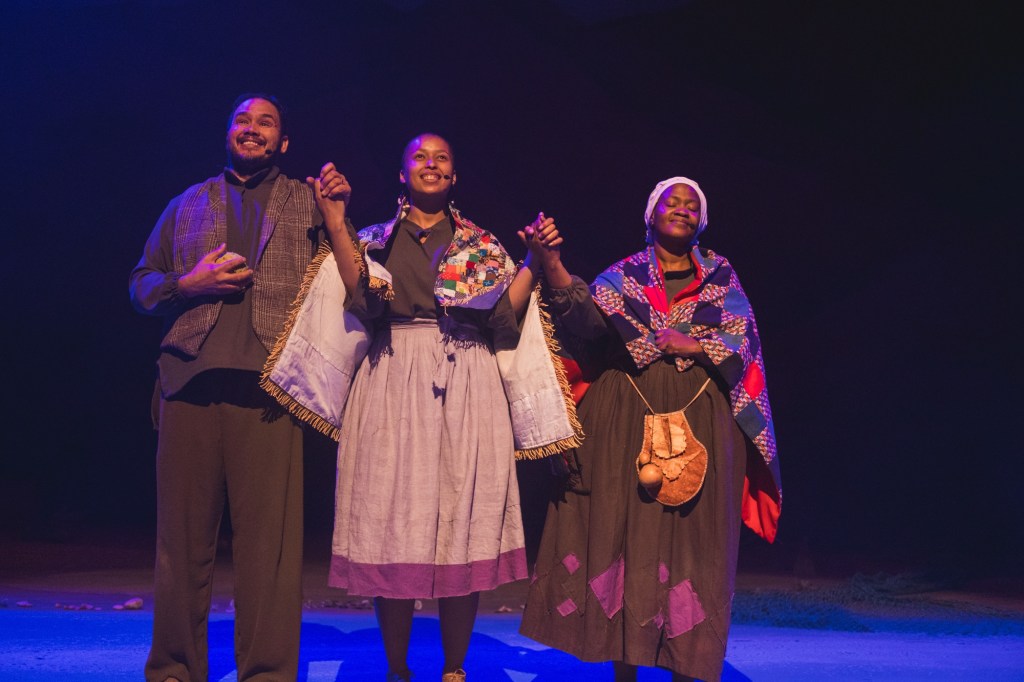
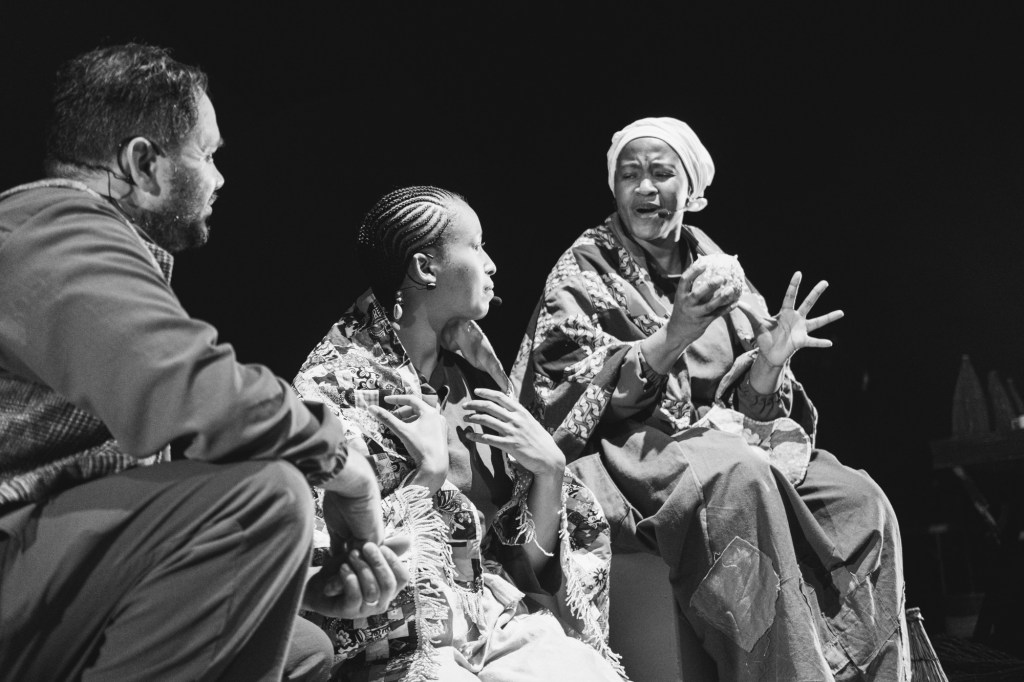
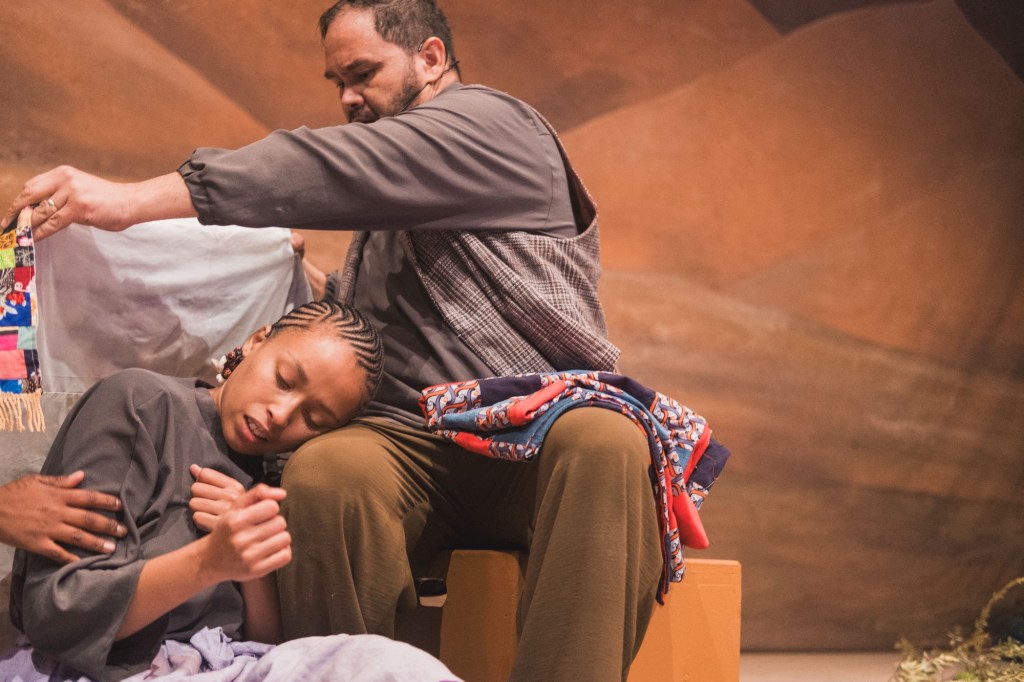
A phenomenal production retelling the story of the ǂAoni people and the ocean. The play consists of a cast of three, the father (Dawie Engelbrecht), the mother played by Hazel Hinda and their daughter Khoendikhoes, played by Chantell Uiras (Diolini). The story follows the three as they revisit the events of the colonial past and how these impacted on the current socioeconomic position of the ǂAoni people, a clan of Nama people mostly found around the !Kuiseb river in the Erongo region also referred to as the Topnaar community.
Setting things straight

One of the main issues covered in this play is that of the history of the community. Colonial era historians alleged that the community’s displacement during the colonial era was in response to countering fighting within the community and harm to the natural environment. The story starts by letting us know who these people were recognized as, ‘the water people’ or guardians of the water and marine life. Their role as caretakers was undermined by the ambitions of the colonizers. It was also clear that they were moved without consultation and that it was carried out in a forceful and chaotic manner. They did not stand a chance against the armed invaders and had no other choice but to comply. An all too familiar history. Before anyone else felt the hit of the colonial invaders, they, being at the coast, felt the first and strongest blows, and because the settling of foreign invaders on the coastal territory did not help their case much.

They spoke of the !Nara fruit (Acanthosicyos horrida), how it was not just food, but the unique way in which each family farmed it was a way to distinguish between families. After the displacement, restoring the practices that were central to their cultural identities has been a struggle not so much because they have lost the capacity to do so, but more because of the policies put in place to make sure that they never do Policies that have seen their way into post-independence Namibia. The play was not made out to be an attack on the contemporary government, but a channel to shed light to the fact that they (the Topnaar community) too are a people that were uniquely disempowered by the apartheid system, and that their story continues to be swept under other emerging and apparent issues. The story has been written in collaboration with academic research institutes like the University of Namibia (UNAM), One Ocean Hub, Global Research Fund, and UK Research and Innovation. Researchers such as Robert Vigne are also amongst those who have showcased the significantly disproportionate level of harm faced by the Topnaar Community during the colonial era. It’s safe to say that the message shared is one grounded in facts not a baseless critique.

When speaking to the audience after the play, a leader from the ǂAonin community, Joel Kooitjie, as well as, acting chief of community Stoffel Anamab, pointed out the struggles that their people continue to face today. Some impacts include the fact that they are only about two Topnaar people in local authority offices and that decision makers in their area can sometimes fail to capture their context very well and ultimately miss their needs. Furthermore, as a community that had largely survived on marine life for sustenance, bearing witness to the harm the ocean and its creatures have faced while disempowered from taking any feasible steps to help serves as a testament to the gradual weakening of their own development, this is in part because a great amount of their income came from inland circulation of oceanic goods. The historical and cultural relevance of ocean governance in this community has been significantly undermined and resulted in having to re-adapt to a life where their strongest skills remain in the backburner. It goes without saying that this need to suppress who they are in order to be convenient for invaders is a level of robbery that digs at the core of personhood.
Conclusion

The play ǂAONI //AES is an example of the Swakopmund Protocole at work. It’s the active reclaiming of a history by the people. It is also an assertion of who they are and who this land has known them to be. The impoverishment and struggle they face today is a result of being subject to a system that has unfortunately kept them down. The post-colonial government canntot take the blame for this, but, in their continuous efforts to decolonize Namibia, they can take the Topnaar Community and their pleas into consideration. 

Black History Month: Triumphant or Tragic in 2023?


Black holidays as I’ve known them have been hecticly traced with tragedy. Unfortunately, all the holidays I have experienced have to do with colonial suffering. This month, at my big age, I found out that a lot of people and institutes in Africa also celebrate Black History Month, something I thought was unique to the experiences of those whose ancestors survived the slave trade, another historic event characterised by Black people suffering. The month came after a long struggle to make sure that Black stories are never lost. I won’t get into the history of it too much, if you’d like a quick history, you can read about it here.

The slave trade and colonial era were undoubtedly an operation of the mass erasing of Black consciousness. A month dedicated to undoing this harm must have been a huge win, considering that the establishment of this this took place between 1970 and 1986 in a more openly and violently racist world. The first celebration kicked of on 2 January till 28 February 1970. Somehow this has moved down to just the 28 days of February and has been clumped up with LGBTQ+ month in the UK.

The decision to have Black History Month in February was in honour of the birth of President Lincoln who is credited for criminalising slavery , and the death of Fredrick Douglass a black former slave and abolitionist.

There is an implication around this that doesn’t sit well with me. Some sense of duplicity I feel when I think that the timing was based on the birth of a white man on a pedestal for admitting that “Black people are people too,” and laying it on the tragic death of a Black man who spent his life fighting to prove this fact and could not enjoy it almost to say ” Celebration for the black people comes throug suffering.” Maybe I’m being too pessimistic in may analysis but something about it highlights the current nature of many African holidays. That they are anchored on the deaths of Black people who died fighting for what they could not experience and exist in the shadow of more lighthearted holidays birthed by white people, like Christmas, Easter Day and April Fool’s Day. Sure we can be a part of the fun, but it is not a fun we designed, it was given to us, and when it’s purely about us, it’s about how much suffering we have apparently overcome.

Maybe I’m just drawing at strings here, but, while I see how Black History Month is worth celebrating, I find it difficult to think of it as less than sad in 2023. If not celebrated, it dismisses efforts put in by Black advocates and activists, if celebrated with full glee then it disregards the fact that this is the bare minimum and that we need to uplift the value of more culturally appreciative holidays. A lot of whitewashing needs to be undone, and many generations have grown with the view that indigenous holidays are ‘evil’, that the bare minimum and assimilation are better than carving out an identity. Let us never forget those who struggled to get us to where we are, and let us move on to honouring who we are. Even if a customary group viewing a holiday is less than a dozen, I still say its better to sing in the joys of the practices that have shaped us, to contribute to the evolution of tradition, rather than to watch customs die and forever sing of the times we suffered like we had no joy.

With that said, happy Black History Month…

Intersectionality and Communication

The concept of intersectionalism can be described as the occurrence of discrimination based on various categories of identity such as race, class and gender .

Kimberle Crenshaw captures the fundamental nature of intersectionalism in her analysis of black women’s existential experience. This was in a time when intersectionalism was not practiced within the political sphere. Her work is particularly essential when highlighting how intersectionalism satisfies the need for inclusive dialogue . She pointed out the harms of a single axis political atmosphere where discriminatory practices and the multiple -isms, are discussed as being mutually exclusive to each other.

What often results in such settings is a favoring of the more privileged among those who are discriminated against. The narratives of those who are privileged in some aspects becomes prioritised. For example, white women not being harmed due to the privilege of being white, Crenshaw refers to the case of Moore v Hughes Helicopter Inc (144), where there was a lack of consideration for the unique experience of black females being separate from the type of discrimination they endured alongside white women.

Communication involves trying establish a common understanding with someone . Taking this under consideration it is essential to note that teaching intersectionalism in communication is vital as a means to capture the, “endemic and everyday nature of racism and sexism and how these other -isms manifest in and through communication.”

Democracy is a tool that should essentially allow for the election of individuals who represent the majority. Which often excludes a significant minority, one may take under consideration, the treatment of the LGBTQ community in Africa as well as that of women in political spheres prior to the 21st century.

In the USA, Kamala Harris represents a remedy of the communication disparity that can result from a lack of consideration for intersectionality. Among the communities she represents, there are black women, Indian women, racially mixed individuals and immigrants. In this regard she can be said to be sensitive to the unique experiences of each of these groups and would be able to convey the concerns of these groups.

This does however raise the question of whether or not she can adequately represent and communicate the needs of groups she is not a part of, such as the LGBTQ community, a question raised in the case of Payne v Travenol, wherein the court concluded that because the plaintiffs were Black women they could not adequately represent the needs of their black male colleagues. Simply put, being oppressed doesn’t mean one can understand the oppression of another.

It is true that the intrinsic nature of suffering that different groups go through cannot always be captured outside the scope of experience, however it is important to have someone who understands that discrimination can manifest in layers rather than as a single arch -ism.

Community movements in Africa do this well by building bridges where intersectional concerns arise. Identifying commonalities has been a useful way to start conversations, with one key one being the colonial era. Relating on the mutual grasp of inequalities that existed back then, makes dialogues in political spaces easier to have.

This isn’t a “save all” technique though, there is a risk of drowning intersectional issues in colonial narratives. On many occasions the colonial narrative has been weaponized by many founding parties as grounds for why they should forever be in power. In such spaces, intersectionality is overpowered by the colonial rhetorics and minimized to “less than” issues.

Striking a balance in intersectionality and communication is key to political change.