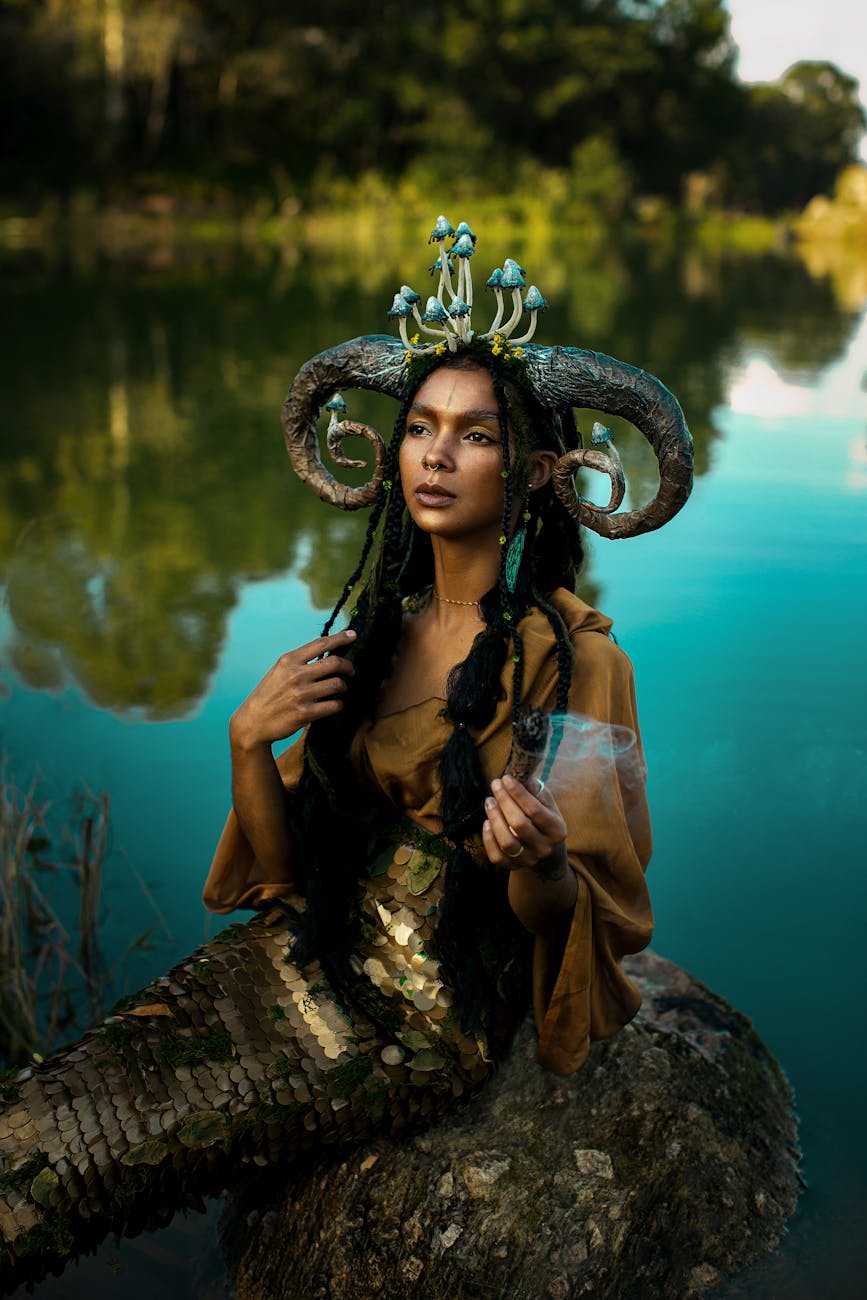

The Story of Zuva and Mwedzi

In the spirit of romance, love and union, I decided to revisit an old folktale I came across some year back about how the world came to be. For a good while, I believed that this was the Shona, world creation story. I’d later find that there were different versions of it, all written with the bold claim of being the single story of how the Shona lore described the creation of the world, each with the same characters, Musikavanhu/Nyadenga (God), Zuva (the Sun), Mwedzi (the moon), Hweva (Morning star) and Morongo (Evening star). 

This story I’ve shared is a blend of all the versions I’ve encountered, enjoy ❤ …

This story goes…

Many years ago, before the great hammer hit the ground and before the world came to be, there was Nyadenga, who sat in constant contemplation. A moment came when he decided to move, in this moment he felt a great joy followed by an intense desire to share this experience. So he created to Zuva, full and fiery with a portion of Nyadenga’s greatest sense of passion and joy. 

After a time, it became clear that Zuva could not relate to Nyadenga, he had a loneliness about him which saddened Nyadenga. On a certain day, Nyadenga shed a tear at the sight of a lonesome Zuva, who’d been yearning for something he’d never known before. Nyadenga kept this tear and breathed life into it. Giving birth to Mwedzi, a companion for Zuva.

The two shared a beautiful romance, and Nyadenga delighted in it. He gave them the ability to realize this love through creation. Together they were amazing creators, Zuva would create beautiful plants and vegetation and show them to Mwedzi, and Mwedzi would create insects, birds and many gentle animals to show to Zuva. The more they created and shared in the beauty of their creations, the more their love grew. Nyadenga had been gifting them with inspiration when they created and stoking their love when they were apart, it gave him a sense of whimsy to do this for them in secret, and the amusement he felt when they’d each come and talk about the other in their private times with Nyadenga, filled him with more gratification than he’d ever anticipated.

Gradually, they grew more and more distant from Nyadenga, relishing only in their union. No longer speaking to their creator, leaning into a vanity over the works they had done.

Nyadenga grew furious at this, after all, the entire reason he created them, was to share the joy of life with them.

He watched as their vanity transformed their love into arrogance, believing they had done it all on their own. He leaned further back when they no longer sought to create as a mark of affection and their once heartfelt devotion to each other turned into competition. 

Their new commitment to outshine each other increasingly became fuelled with spite. Each one determined to prove that their creations were more beautiful, more important, more useful than the other. 

In a moment of rage, Zuva, knowing that Mwedzi’s animals fed on his plants, began to lace some with poison, and sure enough, the animals began to die off. A grief stricken Mwedzi, not knowing how to deal with this deception grew angry at her creations, she had often bragged that her animals were stronger because they could move freely as they pleased and that she could easily command them to stomp on Zuva’s motionless plants if she wished. She never imagined that he would poison them, or that they could succumb to the attack of a motionless creature. Soon after she created more violent animals to hunt down and kill the ones that had embarrassed her. 

This war that grew between Zuva and Mwedzi was felt by their creations. The plants vowed never to speak, fearing their father would set them ablaze. The herbivorous creatures grew more anxious, and uncertain, not knowing why they were punished with such violent siblings. And the carnivorous animals turned on each other, those who revelled in their roles as predators making a sport of attacking those who had sunken into shame and guilt for their violent nature.

Nyadenga could no longer bear the chaos. He called Zuva and Mwedzi and showed them the pain they had been causing. But they were too caught up in their strife to truly care about the harm they were causing to their creations, only choosing to blame each other.

So one day, Nyadenga took from Mwedzi’s smaller carnivores, the snake, which at the time only hunted for mice, and he filled it with poison from one of Zuva’s plants and set it loose. As Zuva paced and inspected his garden, he grabbed this snake with careless rage, mistaking it for a fallen branch and it’s hiss for an expression of disrespect, he had believed the plants honoured him with their silence. 

He felt the poison shoot up and without much time he was with Nyadenga.

Mwedzi would meet a similar fate, when she grabbed the snake to return it closer to the mice after seeing it wonder near Zuva’s garden.

The two pleaded with Nyadenga, begging to be sent back, Nyadenga wouldn’t have it, but he allowed each of them a single ask for their eternal lives in Nyadenga’s house. Mwedzi begged for them to be able to watch over their creations. Nyadenga granted this with the condition that they never do this together, that they were to spend eternity watching over their world apart, and were to never directly interact with their creations as they did before. 

After hearing that their union would not continue in eternity. A teary eyed Zuva begged for a chance to work on one last creation with Mwedzi, as a monument to their love. She accepted this, it hurt her too that their relationship would end, even though it had become so bitter. Together, with the help of Nyadenga they spent time creating mankind and womankind, pouring bits of themselves and their shared love and knowledge into them, and placed them on earth to help keep harmony amongst all creatures.

Soon after they were done, they shared a final kiss and a teary farewell then Nyadenga kept his word and separated them. Calling Zuva’s watch time day time and  Mwedzi’s watch time night time.

They drew nearer to Nyadenga, in their separation and the love that they had shared for each other resurfaced. So Nyadenga, not wanting them to suffer the lonesomeness that had once caused a heartbreaking isolation in Zuva, allowed them to send messengers; Hweva and Morongo, between each other, while keeping the vow that they never meet again.

The End
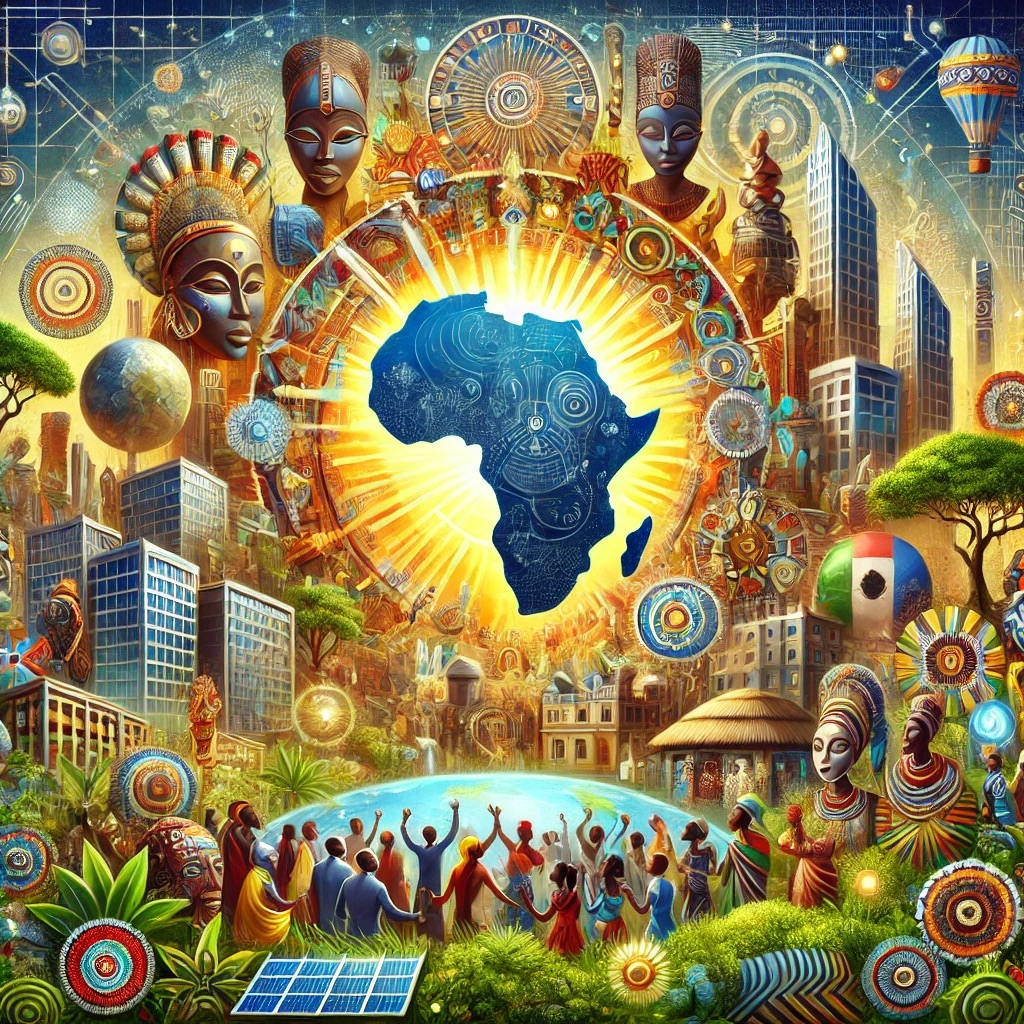
Global Africanism and the African Renaissance

The  African Renaissance is taking place and through it we are fortunate to be at the forefront of seeing Africa take her place in the world. There are ongoing efforts at decolonising several industries, reclaiming narratives as well as embracing and contextualising  cultures. The idea of  Global Africanism looks at where Africa finds herself during this transformative era and how she interacts with her global peers. 

The term was popularised in an edition of the General History of Africa project which was introduced by UNESCO in an effort to support Africans reclaiming their narratives. The purpose of the Global African movement was to bridge the militant goals of the Pan-African movement with the diplomatic efforts of international bodies such as the AU and the UN. On one end, making PanAfricanism fit global diplomacy standards has been seen as a form of giving up and folding over to forceful powers, with leaders such as Malcom X fervently urging his followers to remain distrustful when it came to diplomatic approaches to conflict resolution. On the other hand it is the diplomatic approaches of leaders such as Nelson Mandela, that helped translate PanAfrican goals and get state freedom.

In his 2019 paper A call for a ‘right to development’- informed pan-Africanism in the twenty-first century, Kamga discusses how the rest of the world can take part in the African Renaissance particularly in the realisation of the right to development. That way, he essentially incorporates Global Africanism in his arguments. Outlining how international tools created to maintain diplomatic relations, can be useful pathways for development only if Pan-African goals are centralised rather than the neo-colonialist outcomes that many African countries have become subjected to. This right  is  outlined in Article 22 of the 1981 African Union Charter, the basis of the 2001 New Partnerships for Africa’s Development program by the Au as well as Resolution 41/128 of the UN General Assembly (the Declaration on the Right to Development) and is embodied in the 2030 Agenda for Sustainable Development.

In a 1998 speech Thabo Mbeki made a reference to the Japanese Meiji period when illustrating the possibilities of the African Renaissance, a time of industrialisation for the Japanese and successful resistance to being colonised. In this it’s made clear that  most important means of achieving this is building such an interest, especially amongst the emerging young Africans, to form united African nations, to learn and contextualise what’s working for others, all while maintaining cultural integrity.

Thabo Mbeki spoke a lot about the African Renaissance during his presidency, making clear his ambitions to bring South Africa to a level playing field with global superpowers. This ambition and vision stirred up hope for a much more successful South Africa, but in implementation, he faced criticism for placing so much focus on these diplomatic relations that he’d neglect meeting many South Africans’ immediate needs like employment for a great amount of the youths. That being said, Kamga’s approach seems to address what much of Thabo Mbeki’s approach missed. Voicing how the need to meet practical needs is an international objective that can still be met.

Global Africanism and the African Renaissance are PanAfrican concepts that, not only call for the imagination of a better future, but collaborative efforts to making that future a reality. Kamga makes it clear that the potential exists for everyone to take part in this. We’re one year closer to the Global Agenda for Sustainable Development’s vision 2030 and it’s exciting to see ideas that aim to make PanAfrican goals a reality.

Anita

Anita is a fictional short story of a mother on the search for her daughter, admist frustrating bureaucracy, finding out that she didn’t know her daughter as well as he thought she did and the legend of the Zambezi water goddess Kitapo. It is written in honour of International women’s day, recognizing the lives of women who are extraodinary despite traits that may not be widely likeable or ‘perfect’ but simply because they exist as themselves on a day to day basis, the ancient lore that centers women and the incredible love held by many women who are mothers and daughters.

Anita

Anita woke up to the usual morning routine. Her alarm clock rang at 06:45, but she had hit the snooze button automatically. Anita would drift through some comfortable haze until her body had finally woken her up at 07:10. With bleary eyes, she scrolled through Instagram, chuckling to herself as she passed by memes and checked in to her horoscope. On any given day, she would see a motivational video on YouTube coaxing her out of the morning fog. At 07:20, she would jump out of bed and go through the routines as a matter of course: drag her from her sleep right to the kitchen for a piping hot cup of coffee, on which some Allan Watts-esque video droned in the background, accompanied by a steamy, self-indulgent shower into which she slipped herself-just long enough to clear the remnants of sleep.

This two-year ritual had been part of her life, interspersed periodically with stretching exercises or switching over to Pinterest to get her fix of inspiration. That is, until last week-Tuesday, to be exact-when everything changed. She called in late to work, and at first, coworkers thought she was merely ill and hadn’t called it in to human resources, so they weren’t alarmed. But to her mother, Mai Mushawako, the silence was loud. It was highly out of character for Anita not to call that evening, and highly unusual for her to completely ignore the myriad of messages sent onto her phone.

Anita’s studio apartment was on the ground floor of a newly built estate and told volumes about her Bohemian character. It was decorated with bottles reused as lamps, a shelf full of vinyl records, though sans phonograph, fiction novels, and books on African gods and customs. The walls were pasted with motivating sentences, and plants were thriving on every available nook. Nothing was disturbed; she looked like she had just stepped out, having left no traces of a tussle or kidnapping.

Mai Mushawako had become a fixture in the complex, knocking on doors in a frantic search for her daughter. She was clad in a chitenge, tightly wrapped around her body, with feet dragging in worn flip-flops. Many residents-who, because of her normally polished appearance, could barely recognize her-implored her for information. Each of those questions was tinged with increasing dread, building into a suspicion that maybe, just possibly, one of them knew more than they were letting on. They could not turn a blind eye to her desperate appeals; rather, they almost wished for some sort of answers while at the same time not wanting the worst to be confirmed.

The police at the missing persons’ unit reacted with a shrug, labeling Anita’s absence as youthful rebellion. Detectives Haufiku and Majapo were parents themselves, inured to such cases. When Mrs. Mushawako urged them, they would say some stock phrases: “We are doing our best,” “We are still waiting on more information.” With each rebuff, some of her respect for them eroded, and this amateur sleuthing became her only source of hope.

Mrs Mushawako put together over six months of details about Anita’s life in order to paint a fuller picture. There was Samantha, her close friend, pursuing her PhD in African studies, and a new connection in Anita’s life in the midst of discovering that she had been increasingly interested in the lore of Bantu, aspects of identity that Mai had hardly realized. Anita had been reading stories about their ancestors, learned the totem chants, and the long trek from the Congo basin to Zambezi. Mai felt guilty over the distance she had created between them with her heresies. Was she stifling the inquisitiveness in Anita with dogmatic Christian dogma? In a supposed attempt to piece together what might have been going on, Mai noticed that Anita had been communicating with a Professor Matenga, who was reported to be a specialist on the Kitapo water goddess legend. A water goddess named Kitapo, dear to the Tonga, miraculously shared a love with the Nyaminyami spirit-the walls of colonizers’ dams separating them both. This story, which would otherwise be considered a simple cautionary relationship tale, seemed to take whole new meaning now that her daughter was gone.

Confronting him with raw emotion, her voice cut through the air at a café meeting with the professor. “Have you involved my daughter in ungodly rituals?” she shouted, anger spiraling to despair. He attempted to calm her: “Your daughter has answered a call, wherever she is, she is safe…”. The words fell flat against her growing outrage. She stormed out, leaving the professor bewildered and detectives full of doubt over where this case was headed.


Mai Mushawako drove her Nissan into her village homestead. The loneliness of the journey weighed heavily on her. VaMushawako had remained in South Africa, saying life must go on, but to Mai every quiet moment felt like an eternity of anguish.

Gogo Mushawako sat on a lowly wooden stool, her body worn by time, but the presence of a queen. The two buildings behind her, a modest two-bedroom house built by VaMushawaro and a round hut kitchen, were a testament to the meaning of family and history. As Mai drew closer, Gogo’s knowing eyes met hers; an understanding which needed no words was made.

“I have to tell you what happened to Anita,” Mai started, a quiver in her voice. Gogo cut her off, “Your daughter was here, mwanangu. She has answered the call of Kitapo.” It was like thunder that hit her, sparking an instant storm of denial in her mind. Memories came flooding back-stories of her cousin who disappeared, elders’ whispers accompanying the absence.

“Do not be sad, mwanangu, Gogo said firmly yet calmly. “I will explain it all when the time is appropriate, but she is safe.” The reassurance fell flat – starkly in contrast to the deep bubbling sorrow within Mai. Overwhelmed by all this knowledge, she collapsed into sobs – her terrors fell like waves to the shore.

Her cries echoed in the homestead as neighbours averted their eyes; this was avoidance to not confront the grief they felt was imminent. In that instant, a piece of Mai’s heart broke, an impregnable bond that she felt with her daughter against the fraying mark of uncertainty.


Zenze copyright 2024. All rights reserved